
Quick Answer:
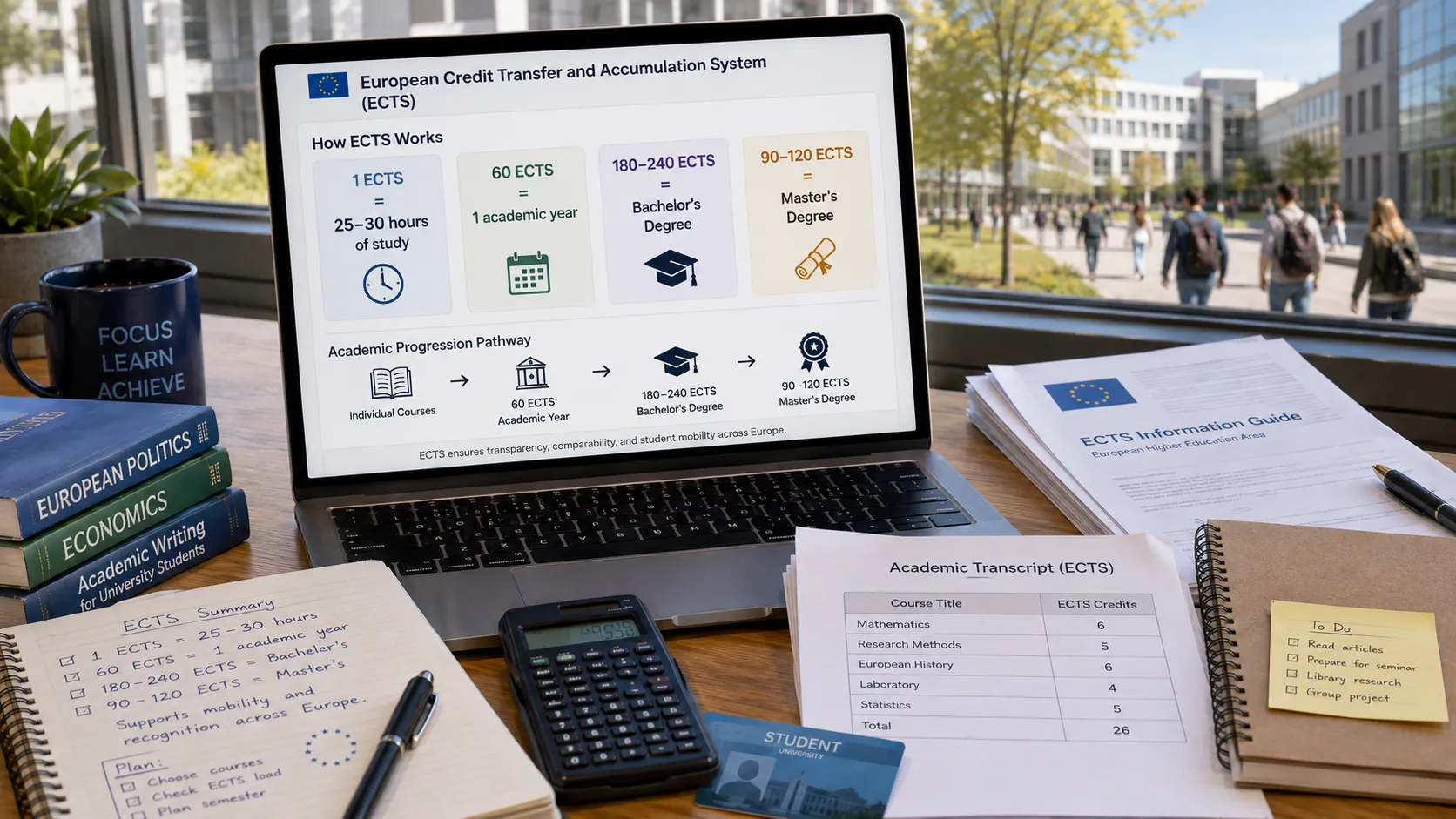
The ECTS (European Credit Transfer and Accumulation System) standardizes academic workload across European universities so that credits can be recognized and transferred between institutions. One ECTS credit equals approximately 25–30 hours of total study. A standard full-time European academic year is worth 60 ECTS credits. Grading itself remains national, but Grade Distribution Tables help universities translate local grades into internationally comparable equivalents.
Key Takeaways
- ECTS standardizes the volume of academic work (credits), not the grading scale — each country still uses its own grade system.
- A standard European Bachelor's degree requires 180 to 240 ECTS credits; a Master's requires 90 to 120.
- The old relative A–F ECTS grading scale has been widely replaced by Grade Distribution Tables, which show where a grade sits within a student's historical cohort.
- 2 ECTS credits generally convert to 1 US Semester Credit Hour for transfer purposes.
- For official US graduate admissions, you still need a certified credential evaluation from a service like WES.
The Problem ECTS Was Designed to Solve
Before 1989, studying across European borders was unnecessarily complicated. A student who completed two semesters at a university in Paris had no reliable way to have those credits recognized when they transferred to a university in Berlin. Each country had its own definition of what a "course" was, how many hours of work it required, and how grades should be assigned.
The result was that student mobility across Europe — which should have been straightforward between neighboring countries — was slow, bureaucratic, and inconsistent. Students often had to repeat courses they had already passed simply because their foreign institution had no system for evaluating whether the work was equivalent.
The European Credit Transfer and Accumulation System was created to fix this. Introduced formally as part of the Bologna Process, ECTS gave every participating European institution a shared framework: one standardized way to measure and communicate the volume of academic work, making transfers, exchange programs, and international recognition dramatically simpler.
What Exactly Are ECTS Credits?
ECTS credits represent academic workload — the total time a typical student needs to invest to achieve the specified learning outcomes of a course.
This includes:
- Lectures and seminars
- Supervised lab sessions
- Independent library research and reading
- Project work and group assignments
- Exam preparation and assessment time
The standard equivalency:
- 1 ECTS credit = approximately 25–30 hours of total work
- 60 ECTS credits = a full academic year (approximately 1,500–1,800 hours of work)
This means that if you pass a 6 ECTS course, your university is certifying that you have successfully completed approximately 150–180 hours of academic engagement with that subject.
Degree Structures Under ECTS
| Qualification | ECTS Credits Required | Typical Duration |
|---|---|---|
| Short-Cycle Qualification | 120 ECTS | 2 years |
| Bachelor's Degree | 180 – 240 ECTS | 3 – 4 years |
| Master's Degree | 90 – 120 ECTS | 1.5 – 2 years |
| PhD / Doctoral | Varies (research-based) | 3 – 5 years |
The ECTS Grading Scale: Old vs. New
The Original Relative A–F Scale
When ECTS was first introduced, it paired the credit system with a relative grading scale. Rather than assigning grades based on an absolute percentage threshold (like the US system), this scale graded students relative to their cohort — where they placed in comparison to their classmates.
The distribution was prescribed as follows:
| ECTS Grade | Definition | Percentage of Passing Students |
|---|---|---|
| A | Excellent | Top 10% |
| B | Very Good | Next 25% |
| C | Good | Next 30% |
| D | Satisfactory | Next 25% |
| E | Sufficient (minimum pass) | Bottom 10% |
| FX | Fail (can re-sit) | — |
| F | Fail (must repeat course) | — |
Why Relative Grading Caused Problems
The relative grading model sounds theoretically fair — it places every student within their specific cohort. But in practice, it created significant problems.
The most serious: small cohorts. If a niche master's program has only 15 enrolled students, the "top 10%" corresponds to barely 1 person. Minor random variation in exam performance could dramatically shift who ends up with an A versus a C. This created unfair outcomes that bore little relationship to absolute academic competence.
Additionally, different institutions interpreted "passing students" differently — some included failed first attempts when calculating distributions, others excluded them. The inconsistency made truly comparable cross-border evaluations difficult.
The Modern Solution: Grade Distribution Tables
The current recommended approach moves away from the prescriptive A–F scale. Universities now produce Grade Distribution Tables (GDT) for each degree program and each course.
A Grade Distribution Table shows, historically, how many students in a specific program received each local grade. For example, a German student who received a "1.5" in their program will have a GDT showing that historically, 12% of students in that program received a 1.5. A foreign university receiving this student's transcript can see exactly how rare or common that grade is — giving them genuine context for fair evaluation.
This approach is far more flexible and statistically honest than forcing every cohort into a fixed distribution.
National Grading Systems Within ECTS
ECTS standardizes credits; grades remain national. Here is how the major European grading systems work:
Germany
Germany uses an inverted numerical scale from 1.0 to 5.0, where 1.0 is the highest possible grade and 5.0 is failing. This confuses international readers who expect higher numbers to mean better performance.
| German Grade | Classification | Approximate US Equivalent |
|---|---|---|
| 1.0 – 1.5 | Sehr Gut (Very Good) | A (4.0) |
| 1.6 – 2.5 | Gut (Good) | B+ to A- (3.3 – 3.7) |
| 2.6 – 3.5 | Befriedigend (Satisfactory) | B- to B (2.7 – 3.0) |
| 3.6 – 4.0 | Ausreichend (Pass) | C to C+ (2.0 – 2.3) |
| 4.1 – 5.0 | Nicht Bestanden (Fail) | F (0.0) |
France
The French grading system runs from 0 to 20, where 20 is the maximum. Scoring above a 16/20 is exceptionally rare — French academic culture is famously conservative in awarding top marks. A 14/20 is considered a strong grade.
| French Score | Classification | US Equivalent |
|---|---|---|
| 16 – 20 | Très Bien (Excellent) | A (4.0) |
| 14 – 15.9 | Bien (Very Good) | A- (3.7) |
| 12 – 13.9 | Assez Bien (Good) | B (3.0 – 3.3) |
| 10 – 11.9 | Passable (Pass) | C (2.0 – 2.7) |
| Below 10 | Fail | F (0.0) |
Netherlands
The Netherlands uses a scale from 1 to 10, with 10 being perfect (though grades above 9 are extremely rare). A 5.5 is the minimum passing grade at most Dutch universities.
Spain
Spain uses a 0 to 10 scale with four main categories:
- Notable (7 – 8.9): Good performance
- Sobresaliente (9 – 10): Outstanding
- Matrícula de Honor: The highest possible distinction, awarded only to the top 5% of students
Converting ECTS Credits to US and UK Standards
ECTS to US Credits
The widely accepted conversion rule for academic transfers is:
2 ECTS credits = 1 US Semester Credit Hour
This means:
- A 6 ECTS European course = a 3-credit US course
- A full 60 ECTS European academic year = 30 US semester credit hours
- A 180 ECTS Bachelor's degree = 90 US semester credit hours (equivalent to a typical US Bachelor's)
ECTS to UK Credits (CATS)
The UK uses its own Credit Accumulation and Transfer Scheme (CATS):
1 ECTS credit = 2 UK CATS credits
A standard UK Bachelor's degree requires 360 CATS credits, which aligns with 180 ECTS.
Converting European Grades to 4.0 GPA (for US Applications)
The grade conversion is significantly more complex than the credit conversion because of the diversity of national grading philosophies. There is no single reliable mathematical formula.
For an initial personal estimate, our Percentage to GPA Converter can help you map your local European grade to a 4.0 scale equivalent.
For official US graduate school applications, you must submit your transcripts to a NACES-certified credential evaluator (such as WES or ECE). These organizations maintain country-specific and institution-specific grading context databases to ensure your European degree is evaluated accurately.
Erasmus+ and ECTS in Practice
The most visible practical application of ECTS is the Erasmus+ program — the European Union's flagship student mobility initiative. Every year, hundreds of thousands of students use Erasmus+ to study at a partner university in another country.
ECTS makes this possible. Because every participating university speaks the same "credit language," your home university knows exactly how much work you completed abroad and can recognize those ECTS credits without requiring you to retake equivalent courses domestically.
The process:
1. Before departure, you and your home institution sign a Learning Agreement specifying which courses you will take abroad and confirming they will be recognized.
2. After completion, the host university provides you with a Transcript of Records listing your ECTS credits and local grades.
3. Your home institution recognizes these according to the Learning Agreement, converting them to local credits.
Frequently Asked Questions (FAQ)
Can I transfer ECTS credits to the UK after Brexit?
Yes. UK universities still recognize ECTS credits for exchange and transfer purposes, even though the UK formally left the EU. UK institutions negotiate their own recognition agreements with European partners.
Does failing a course affect my ECTS credit total?
No. You only accumulate ECTS credits for successfully passed courses. A failed course contributes zero credits, regardless of how many hours you invested in studying for it.
Are ECTS credits recognized in the United States?
ECTS credits are not directly recognized by US institutions as they stand. They must be converted to US semester credit hours through a credit equivalency evaluation. The 2:1 ratio (2 ECTS = 1 US credit) is widely accepted.
Is ECTS used outside of Europe?
ECTS is an EU-originated framework, but its logic and structure have influenced academic credit systems globally. Many universities in Australia, parts of Asia, and Latin America reference ECTS when building cross-border recognition agreements.
If I get an ECTS Grade A, does that mean I am in the top 10% globally?
No. The ECTS Grade A (under the old relative scale) means you are in the top 10% of the passing students in your specific cohort at your specific institution. It is a local ranking, not a global one.
Summary
The ECTS system is one of the most successful academic standardization initiatives in history, enabling millions of students to move freely between European universities without losing their academic progress. By standardizing the volume of work (credits) while allowing national grading philosophies to remain intact, it balances uniformity with local academic culture.
For students looking to take their European credentials to international markets — particularly North America — the key practical steps are: understand your national grading scale, use Grade Distribution Tables to add context to your transcript, and commission a certified credential evaluation for formal applications. The official European Credit Transfer and Accumulation System (ECTS) guide from the European Commission is the authoritative reference for any questions about how credits and grades are officially defined.
If you are trying to estimate how your European grades stack up against the requirements for graduate programs abroad, read our guide on What is a Good CGPA for a Master's Abroad?. For a global comparison of all major grading systems, visit our GPA Conversion Charts guide.