Quick Answer:
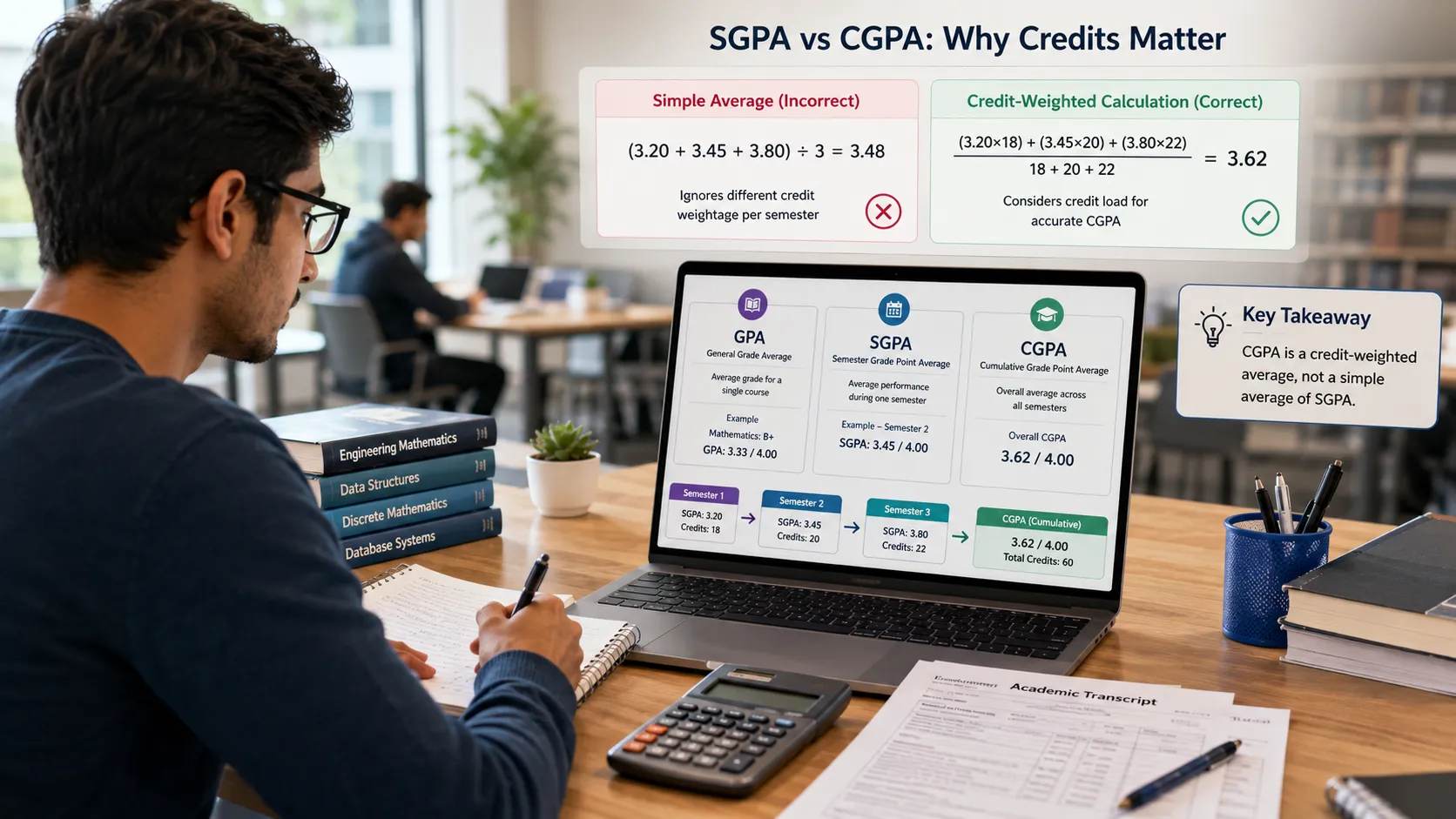
GPA (Grade Point Average) is the broad term for an academic average. SGPA (Semester Grade Point Average) measures your performance for one specific term and resets at the start of each new semester. CGPA (Cumulative Grade Point Average) is the weighted average of all your semesters combined and is the definitive metric on your final transcript.
Key Takeaways
- GPA is often used as a catch-all term in the US; SGPA and CGPA provide more specific temporal context used in international systems.
- Your SGPA is a fresh start every semester — it only reflects the courses you took during that term.
- Your CGPA is a running weighted total of your entire academic career and cannot be easily reset.
- Calculating CGPA by simply averaging your SGPAs is mathematically incorrect unless all semesters had identical credit loads.
- Employers and graduate programs primarily evaluate CGPA, not individual semester SGPAs.
The Acronym Confusion Is Real
Walk into any university administrative office, and you will hear GPA, SGPA, and CGPA used almost interchangeably. This casual blurring is harmless in hallway conversation — but it becomes a real problem when you are filling out graduate school applications, reporting your standing to employers, or trying to understand why your transcript looks the way it does.
All three terms represent mathematical averages of your academic performance. But they measure entirely different timeframes, carry different weights in decision-making, and are calculated using different inputs. Understanding the distinction is not just academic trivia — it is essential for accurate self-presentation at every stage of your career.
1. What Is GPA (Grade Point Average)?
The Broad Definition
GPA is the most generic of the three terms. It simply refers to the numerical representation of your grade average on a standardized scale — most commonly a 0.0 to 4.0 scale in North America or a 0 to 10-point scale in South and Southeast Asia.
In the United States, when an employer says "list your GPA," they almost always mean your overall cumulative average. However, "GPA" on its own does not inherently specify a time period. It only becomes meaningful when you understand whether it refers to a single term or your entire academic history.
GPA in a US Context
In American universities, the concept of a "semester GPA" and a "cumulative GPA" exist, but they are rarely called SGPA and CGPA. Instead, your transcript simply shows your term GPA (for each semester) and your cumulative GPA (your running total). The term "CGPA" and "SGPA" are more commonly used in Indian, Pakistani, Bangladeshi, Sri Lankan, and several African university systems — standardized in India through the framework set by the University Grants Commission (UGC).
How GPA Points Are Assigned
In most 4.0-scale systems, letter grades translate to grade points as follows:
| Letter Grade | Grade Points |
|---|---|
| A (90–100%) | 4.0 |
| A- (87–89%) | 3.7 |
| B+ (83–86%) | 3.3 |
| B (80–82%) | 3.0 |
| B- (77–79%) | 2.7 |
| C+ (73–76%) | 2.3 |
| C (70–72%) | 2.0 |
| D (60–69%) | 1.0 |
| F (Below 60%) | 0.0 |
2. What Is SGPA (Semester Grade Point Average)?
A Fresh Start Every Term
Your SGPA is a snapshot — a precise measurement of your academic performance during one specific, isolated term. Whether your university uses a semester system, a trimester system, or a quarter system, the SGPA calculation covers only the courses you completed during that period.
When the new semester begins, your SGPA counter resets to zero. You are starting fresh, regardless of how you performed previously. This is what makes SGPA both a pressure valve and a warning system.
How SGPA Is Calculated
The formula for SGPA is:
SGPA = Σ (Course Grade Points × Course Credit Hours) ÷ Total Credit Hours for the Semester
Example:
You take three courses in Semester 1:
| Course | Credits | Grade | Grade Points | Quality Points |
|---|---|---|---|---|
| Mathematics | 4 | A (4.0) | 4.0 | 16 |
| English | 3 | B (3.0) | 3.0 | 9 |
| Physics | 3 | B+ (3.3) | 3.3 | 9.9 |
| Total | 10 | — | — | 34.9 |
SGPA = 34.9 ÷ 10 = 3.49
Why Universities Monitor SGPA
Universities use SGPA as an early warning system. If your SGPA drops below a minimum threshold (typically 2.0 on a 4.0 scale) in a single term, you may be placed on academic probation, regardless of your historical CGPA. It allows institutions to identify students who are struggling now and intervene before the damage becomes permanent.
Conversely, a high SGPA in your final semesters signals a positive trend — something graduate school admissions officers do pay attention to, especially when your overall CGPA is borderline.
3. What Is CGPA (Cumulative Grade Point Average)?
The Definitive Metric
CGPA is the heavyweight of the three. It is the weighted average of every grade you have received across every semester of your entire degree program. Unlike SGPA, your CGPA never resets. It accumulates data from your very first semester to your very last, creating a comprehensive picture of your sustained academic performance.
This is the number that appears in bold on your final degree transcript. This is the number employers screen for, scholarships are awarded against, and graduate programs use to rank applicants.
How CGPA Is Calculated
CGPA = Total Accumulated Quality Points ÷ Total Accumulated Credit Hours
Where Quality Points = Grade Points × Credit Hours for each course.
Extended Example:
| Semester | Credit Hours | Quality Points | SGPA |
|---|---|---|---|
| Semester 1 | 15 | 52.5 | 3.50 |
| Semester 2 | 18 | 57.6 | 3.20 |
| Semester 3 | 12 | 42.0 | 3.50 |
| Semester 4 | 18 | 63.0 | 3.50 |
| Total | 63 | 215.1 | — |
CGPA = 215.1 ÷ 63 = 3.41
Why CGPA Becomes Harder to Change Over Time
This is a mathematical reality many students do not fully grasp until too late. Because your CGPA is a weighted average of an increasingly large pool of credit hours, each additional semester contributes proportionally less to the overall number.
In your first semester (15 credits), a 4.0 SGPA has enormous leverage over your CGPA. By your final semester, if you have already accumulated 48 credits, your final 15-credit semester accounts for only 24% of your total academic record. This is why students who perform poorly in their first year struggle to rescue their CGPA even with straight A's later on — and why those who start strong have a significant structural advantage.
The Most Common Calculation Mistake
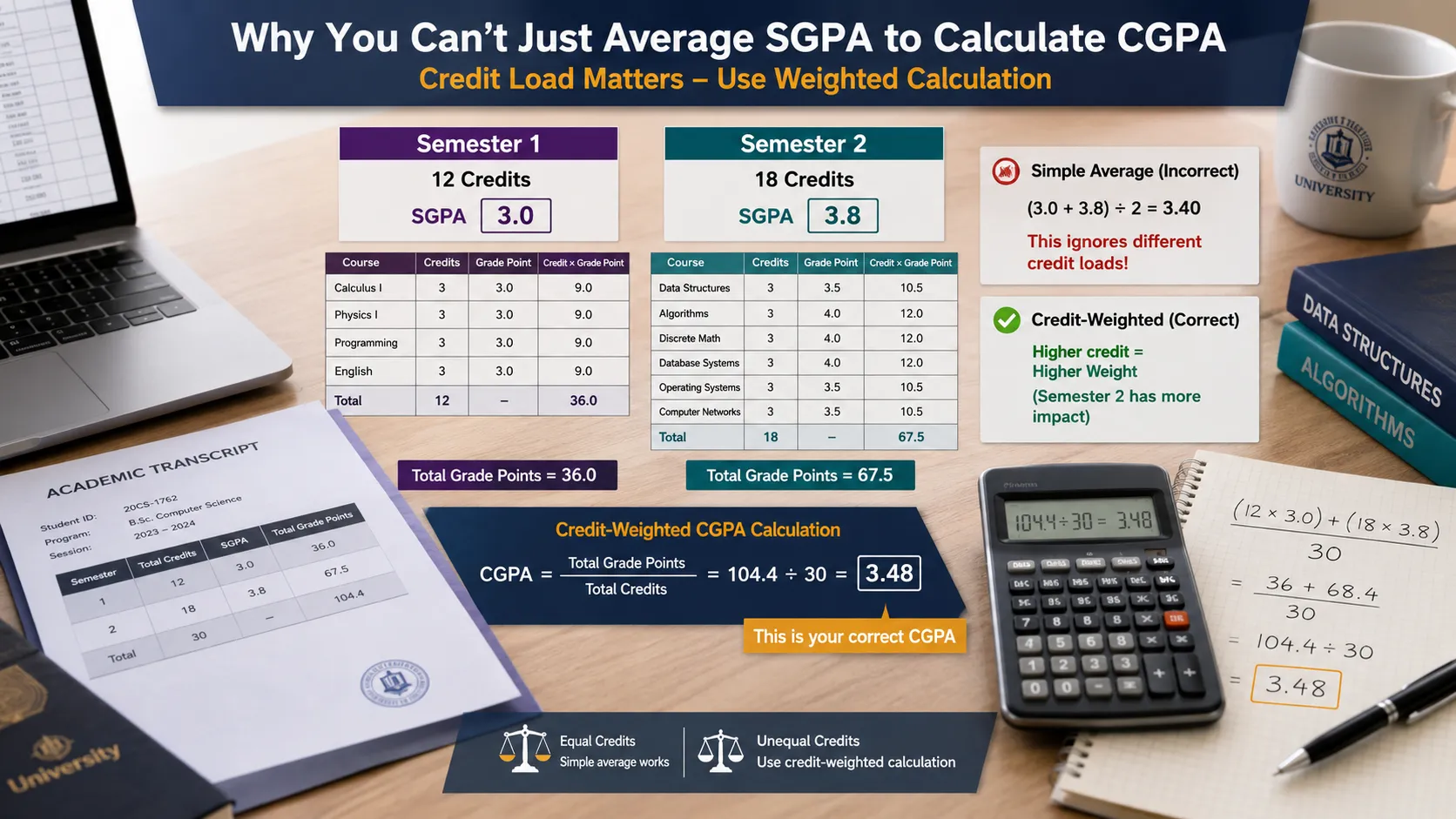
The single most frequent error students make when trying to calculate their own CGPA is averaging their SGPAs directly:
Incorrect:
- Semester 1 SGPA: 3.0
- Semester 2 SGPA: 3.8
- Student calculates: (3.0 + 3.8) ÷ 2 = 3.4 CGPA
This is only correct if both semesters had identical credit loads. If Semester 1 had 12 credits and Semester 2 had 18 credits, your CGPA is not 3.4. The heavier semester carries more weight.
Correct Calculation:
| Semester | Credits | SGPA | Quality Points |
|---|---|---|---|
| Semester 1 | 12 | 3.0 | 36.0 |
| Semester 2 | 18 | 3.8 | 68.4 |
| Total | 30 | — | 104.4 |
CGPA = 104.4 ÷ 30 = 3.48 (not 3.4)
To avoid this error entirely, use our CGPA Calculator. It handles credit-weighted averaging automatically so you always get the accurate cumulative score.
Which Metric Actually Matters for Your Future?
This is a practical question with a direct answer:
For Employment
Employers look at your CGPA. They set a minimum cutoff (commonly 6.5/10 or 3.0/4.0) and filter all applications below it without review. Your SGPA from any specific semester is almost never requested unless you are in a co-op program where semester-by-semester evaluation is built into the process.
For Graduate School Admissions
Graduate programs evaluate your CGPA as the primary academic filter. However, a strong upward trend in your final-year SGPAs can be mentioned in your Statement of Purpose and will be considered favorably — particularly if your overall CGPA is below the preferred threshold.
For Scholarships
Scholarships set CGPA cutoffs. Some also check your most recent semester's SGPA to confirm you are maintaining academic momentum. Meeting both thresholds is typical for merit-based awards.
For Placement Drives (India)
On-campus recruitment in India is heavily CGPA-gated. Most top-tier companies set a strict 7.5/10 cutoff. Students below the cutoff are not allowed to sit for the placement test, regardless of other achievements.
Frequently Asked Questions (FAQ)
Is a 10.0 CGPA the same as a 4.0 GPA?
No. The 10-point CGPA scale and the 4.0 GPA scale use different structural logic and cannot be converted by simple division. A 10.0/10.0 CGPA would represent an outstanding student equivalent to roughly a 4.0 GPA, but the relationship at lower scores is not linear. Use our Percentage to GPA Converter for an accurate mapping.
Do employers ever ask for SGPA?
Rarely, and only in specific contexts. Some co-operative education programs and internship hiring cycles evaluate your most recent semester SGPA. Most general employers only want your final cumulative CGPA.
Can my CGPA drop even if my SGPA is high?
No. Mathematically, if your SGPA for any given term is higher than your existing CGPA, your CGPA will always increase (or stay the same). It is impossible for a term with an above-average SGPA to lower your cumulative average.
How many credits does it take to meaningfully improve a bad CGPA?
It depends on the gap. To raise a 2.0 CGPA to a 2.5 with a 4.0 SGPA, you need roughly the same number of credit hours you have already completed. The larger the gap and the more credits you have accumulated, the harder the recovery becomes. This is why early intervention is so critical.
Summary
SGPA and CGPA serve different purposes in the academic ecosystem. Your SGPA is a regular progress check — a term-by-term snapshot that indicates whether you are academically healthy right now. Your CGPA is your permanent academic record — the number that follows you to job applications, graduate school interviews, and scholarship committees for years after graduation.
The most important practical takeaway: never average your SGPAs to calculate your CGPA. Always use credit-weighted calculations or a reliable tool. Start strong, because early semesters have the greatest mathematical leverage over your final cumulative score.
For a step-by-step breakdown of how to track your SGPA effectively throughout your degree, read our guide on How to Track Your SGPA Each Semester.