
Quick Answer:
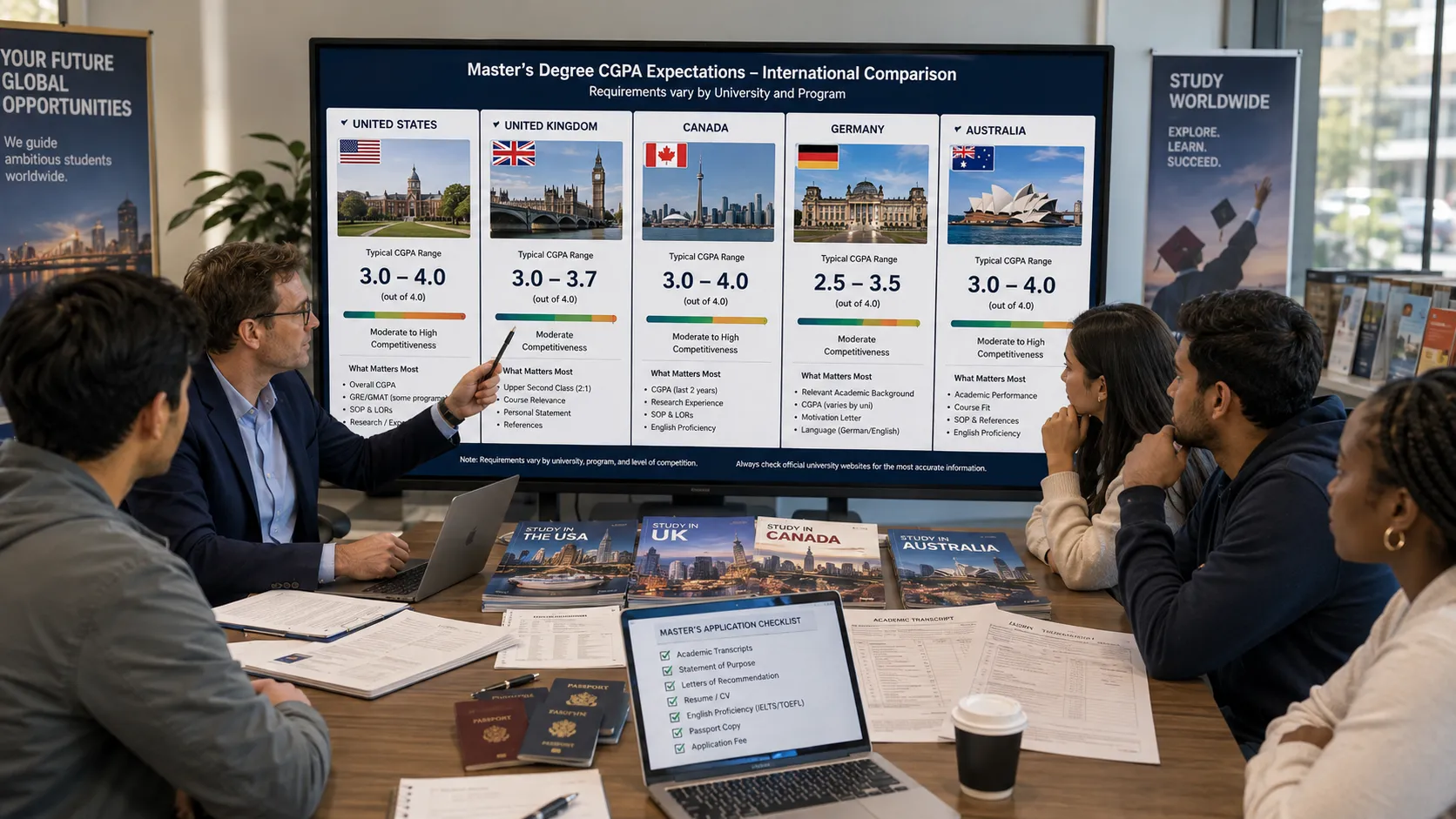
For top-tier universities in the US and Canada, a competitive CGPA is generally 3.5 to 4.0 on a 4.0 scale — equivalent to a 8.5 to 10.0 on India's 10-point scale, or a First-Class Honours in the UK. Most accredited Master's programs worldwide enforce a minimum cutoff of 3.0 GPA (or equivalent). Strong GRE/GMAT scores, research experience, and a compelling Statement of Purpose can offset a CGPA that falls slightly below the target.
Key Takeaways
- The definition of "good" changes dramatically by country, university tier, and specific program — one number does not fit all.
- A 3.0 GPA (US scale) is the near-universal baseline minimum for international Master's admissions.
- The UK focuses on degree classification (First, 2:1) rather than a numerical GPA.
- Canada gives significant weight to your final two undergraduate years, not just your overall cumulative average.
- German universities prioritize curriculum alignment between your Bachelor's and the chosen Master's program alongside your grade.
- A low CGPA is not an automatic rejection — holistic applications with strong supporting elements are regularly accepted at competitive programs.
Why There Is No Single "Good" CGPA
This is the question nearly every international student asks before applying for graduate study abroad. The frustration is understandable: you want a specific target number to aim for. The honest answer is that no single threshold applies globally.
A 75% from a UK university and a 75% from an Indian engineering university represent vastly different levels of academic difficulty. A 7.5/10 CGPA from a tier-1 Indian Institute of Technology carries different weight than the same score from a lesser-ranked institution. And a 3.5 GPA that gets you into a solid US state university program might fall short of an Ivy League program's expectations.
What you can do — and what this guide helps you do — is understand the specific benchmarks for each major study destination, so you know where you realistically stand before investing application fees and months of preparation.
United States
The Landscape
The US hosts the largest number of international graduate students in the world, and its universities collectively represent the most diverse range of admission thresholds. At one end are institutions that routinely reject applicants with 4.0 GPAs. At the other end are accredited programs that accept students with a 2.7 GPA if supporting credentials are strong.
CGPA Benchmarks by University Tier
| University Tier | Minimum GPA (4.0 Scale) | Equivalent 10-Point CGPA |
|---|---|---|
| Elite (MIT, Stanford, Ivy League) | 3.7 – 4.0 | 9.0 – 10.0 |
| Top Research Universities | 3.5 – 3.7 | 8.5 – 9.0 |
| Strong State Universities | 3.0 – 3.5 | 7.5 – 8.5 |
| Mid-Tier Accredited Programs | 2.7 – 3.0 | 7.0 – 7.5 |
These are general benchmarks. Programs in high-demand fields like Computer Science, Electrical Engineering, and Business typically have higher effective minimums than programs in humanities or social sciences — even at the same university.
The GRE Factor
Many US programs require the GRE (Graduate Record Examination). A strong Quantitative score (above 160/170) can significantly offset a borderline GPA, particularly for STEM Master's programs. It mathematically demonstrates to the admissions committee that your low undergraduate grades were situational, not indicative of intellectual capacity.
United Kingdom
How the UK Evaluates Grades
UK universities rarely request a numerical GPA. They evaluate undergraduate performance through the Honours degree classification system:
| UK Classification | Typical Percentage | Approximate US GPA |
|---|---|---|
| First-Class Honours | 70% and above | 3.7 – 4.0 |
| Upper Second (2:1) | 60% – 69% | 3.3 – 3.7 |
| Lower Second (2:2) | 50% – 59% | 2.7 – 3.3 |
| Third-Class Honours | 40% – 49% | 2.0 – 2.7 |
What UK Programs Expect
| University Tier | Typical Requirement |
|---|---|
| Oxford, Cambridge, Imperial College | First-Class Honours (typically 70%+ or 9.0+ on 10-point scale) |
| Russell Group (Top 24 Research Universities) | Upper Second-Class Honours (2:1) — approximately 7.5+ on 10-point scale |
| Modern Universities and Specialist Colleges | Lower Second-Class Honours (2:2) often accepted |
For international students: UK universities map your home country's grades to these classifications using country-specific equivalency tables. A student from India with a 7.5/10 CGPA will typically be considered equivalent to a 2:1 (Upper Second), making them eligible for most Russell Group programs.
Canada
Why Canada Is Different
Canadian graduate admissions are notable for placing significant weight on your final two years of undergraduate study rather than your overall cumulative average. This is a meaningful advantage for students who had a difficult first or second year but improved significantly in their junior and senior years.
CGPA Benchmarks by University
| University | Typical Minimum | What They Emphasize |
|---|---|---|
| University of Toronto | B+ (76%+ or ~3.3 GPA) | Final 2 years of undergraduate study |
| McGill University | B (3.0 GPA) | Last 2 years, strong letters of recommendation |
| University of British Columbia | B+ (76%+, or 3.3 GPA) | Last 2 years preferred |
| Other Accredited Universities | B (3.0 GPA) | Overall CGPA |
Key insight for Indian applicants: If your 10-point CGPA is 7.5 overall but you scored 8.5+ in your third and fourth year, Canadian universities will view your application significantly more favorably than those that only look at cumulative scores. Highlight your final-year SGPAs prominently in your Statement of Purpose.
Germany
Why Germany Is Unique
Germany is one of the most popular study-abroad destinations, particularly for engineering and technology students, largely because of minimal tuition fees at public universities. However, the German admissions process evaluates academic credentials very differently from North American or British institutions.
The German Grading Scale
German universities use a 1.0 to 5.0 scale where 1.0 is the best grade (counterintuitively for most international applicants):
| German Grade | Classification | Requirement for Admission |
|---|---|---|
| 1.0 – 1.5 | Sehr Gut (Very Good) | Competitive for all programs |
| 1.6 – 2.5 | Gut (Good) | Acceptable for most programs |
| 2.5 – 3.5 | Befriedigend (Satisfactory) | Borderline — may need subject knowledge compensation |
| Above 3.5 | Generally insufficient | Most programs require better |
For international students applying to English-taught Master's programs in Germany, a rough equivalent guideline is:
- CGPA 8.5+ (10-point) or GPA 3.5+ (4.0): Competitive for TU Munich, RWTH Aachen, KIT
- CGPA 7.5+ (10-point) or GPA 3.0+ (4.0): Viable for most other German public universities
The Curriculum Matching Requirement
What makes Germany unique is that curriculum matching often matters more than your GPA. If you are applying for an MSc in Electrical Engineering, German universities will check whether your Bachelor's transcript includes specific prerequisite courses — Signals and Systems, Control Theory, Circuit Theory, etc. — in sufficient depth and quantity (often measured in ECTS credits).
A student with a perfect GPA who lacks the specific prerequisite coursework may be rejected, while a student with a slightly lower GPA who completed all required subjects may be accepted.
Australia
Australian universities use their own GPA scale (typically 0–7 or 0–4 depending on the institution) alongside percentage grades.
| Australian Grade | Points (7-point scale) | Approximate US GPA |
|---|---|---|
| High Distinction | 7 | 4.0 |
| Distinction | 6 | 3.7 |
| Credit | 5 | 3.0 |
| Pass | 4 | 2.0 |
For international applicants, the general benchmark for Australian Group of Eight (Go8) universities is a GPA equivalent to a 3.0 US GPA or above. Many programs at top Australian universities (University of Melbourne, University of Sydney, ANU) prefer students with the equivalent of a 3.5+ for competitive programs.
How to Strengthen an Application With a Low CGPA
A CGPA below the preferred threshold does not automatically eliminate you. Admissions committees at most graduate programs conduct holistic reviews. Here is how to build the strongest possible application:
1. Score High on the GRE or GMAT
A Quantitative GRE score in the 90th percentile (160+/170) is one of the most powerful ways to demonstrate intellectual capability independently of your undergraduate grades. For MBA programs, a GMAT score above 700 achieves the same effect.
2. Gain Relevant Professional Experience
One to three years of work experience in a directly relevant field signals professional maturity and practical competence. Many programs — particularly in business and policy — actually prefer applicants with work experience. Real-world experience compensates for academic gaps in a way that few other credentials can.
3. Write a Compelling Statement of Purpose
Your SOP is your single opportunity to contextualize your transcript. If your CGPA dipped in a specific year due to health issues, family emergencies, or financial difficulties, address it directly in a single paragraph. Do not dwell on it — explain it, demonstrate what you learned, and pivot to your strengths.
Equally importantly, highlight your upward grade trend if your final semesters show significantly improved performance compared to your early years.
4. Target Programs With a Research Focus
Research-intensive programs (particularly those that lead to thesis-based Master's degrees or PhD positions) frequently place more weight on research experience, publications, or strong letters of recommendation from recognized academics than on GPA alone. Demonstrating genuine intellectual contribution to a field carries significant weight.
5. Consider a Bridge or Postgraduate Certificate
Some universities offer bridge programs or postgraduate certificate courses specifically designed for students who do not fully meet Master's admissions criteria. Completing one of these with a strong GPA can serve as the academic proof-of-concept that unlocks admission to the full degree program the following year.
Converting Your CGPA for Applications
Before applying to any international program, you need to understand how your home country's grades will be interpreted. Our CGPA Calculator lets you aggregate all your semester grades into a single cumulative score. If your university uses percentage marks rather than a GPA scale, use our Percentage to GPA Converter to get an approximate 4.0-scale equivalent.
For formal applications, always commission a certified credential evaluation from WES (World Education Services) or an equivalent NACES member organization. Self-reported conversions are useful for planning — they are not accepted as official documentation.
Frequently Asked Questions (FAQ)
Does completing a Master's degree erase a poor undergraduate CGPA?
Effectively, yes. Once you hold a graduate degree with a strong GPA, employers and PhD programs focus primarily on your most recent, highest qualification. Your undergraduate record becomes a historical footnote rather than an active factor in most professional decisions.
Can I get accepted to a Master's program with a 2.5 GPA?
It is challenging for highly ranked programs but not impossible. Your best options include targeting programs with more flexible admissions, completing a postgraduate certificate to prove your competence, or applying after two or more years of highly relevant professional experience.
Do online certificates from Coursera or edX help offset a low GPA?
They demonstrate initiative and a willingness to learn, which is always positive. However, they are not equivalent to accredited university credits and will not significantly move the needle on competitive academic admissions. A strong GRE score or professional experience carries far more weight.
Should I apply to reach schools even with a borderline GPA?
Yes. Admissions are holistic at most programs. If your GRE is excellent, your research or work experience is relevant, and your Statement of Purpose is compelling, a slightly below-average GPA does not disqualify you. Apply strategically — include target schools, likely schools, and one or two reach schools in every application cycle.
Summary
The CGPA you need for a Master's abroad depends on the country, the university tier, and the specific program. As a working rule, aim for a 3.5+ on the 4.0 scale (or equivalent) to be competitive at strong programs globally. A 3.0 is the baseline minimum at most accredited programs. Below that, a holistic application strategy — combining strong test scores, relevant experience, and a well-crafted SOP — is essential.
Start by knowing exactly what your cumulative CGPA is. Use our CGPA Calculator to get an accurate number. Then use our Percentage to GPA Converter if your transcript uses percentage marks. Once you have your number, this guide tells you exactly where you stand.