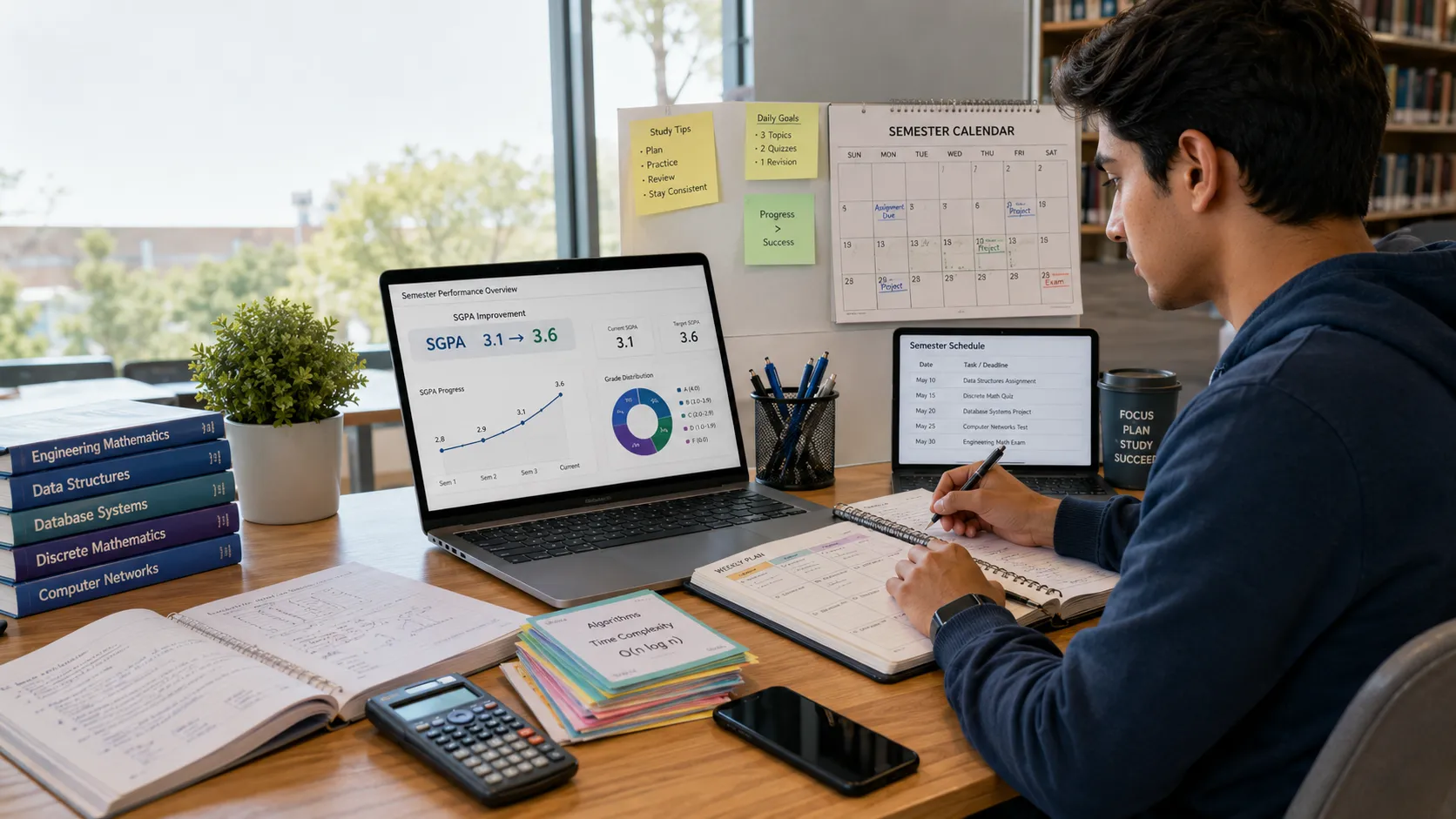
Quick Answer:
To improve your semester GPA, shift from passive reading to active recall, use a digital GPA tracker to monitor your standing weekly, and allocate your heaviest study time to your highest-credit courses. These three changes alone — consistent for a full semester — will produce measurable grade improvement. The rest comes down to systematic execution: attending office hours early, building a study group, and protecting your sleep.
Key Takeaways
- Active recall (forcing your brain to retrieve information without looking at notes) is dramatically more effective than re-reading for exam performance.
- Tracking your grades weekly with a calculator prevents end-of-semester surprises and enables timely correction.
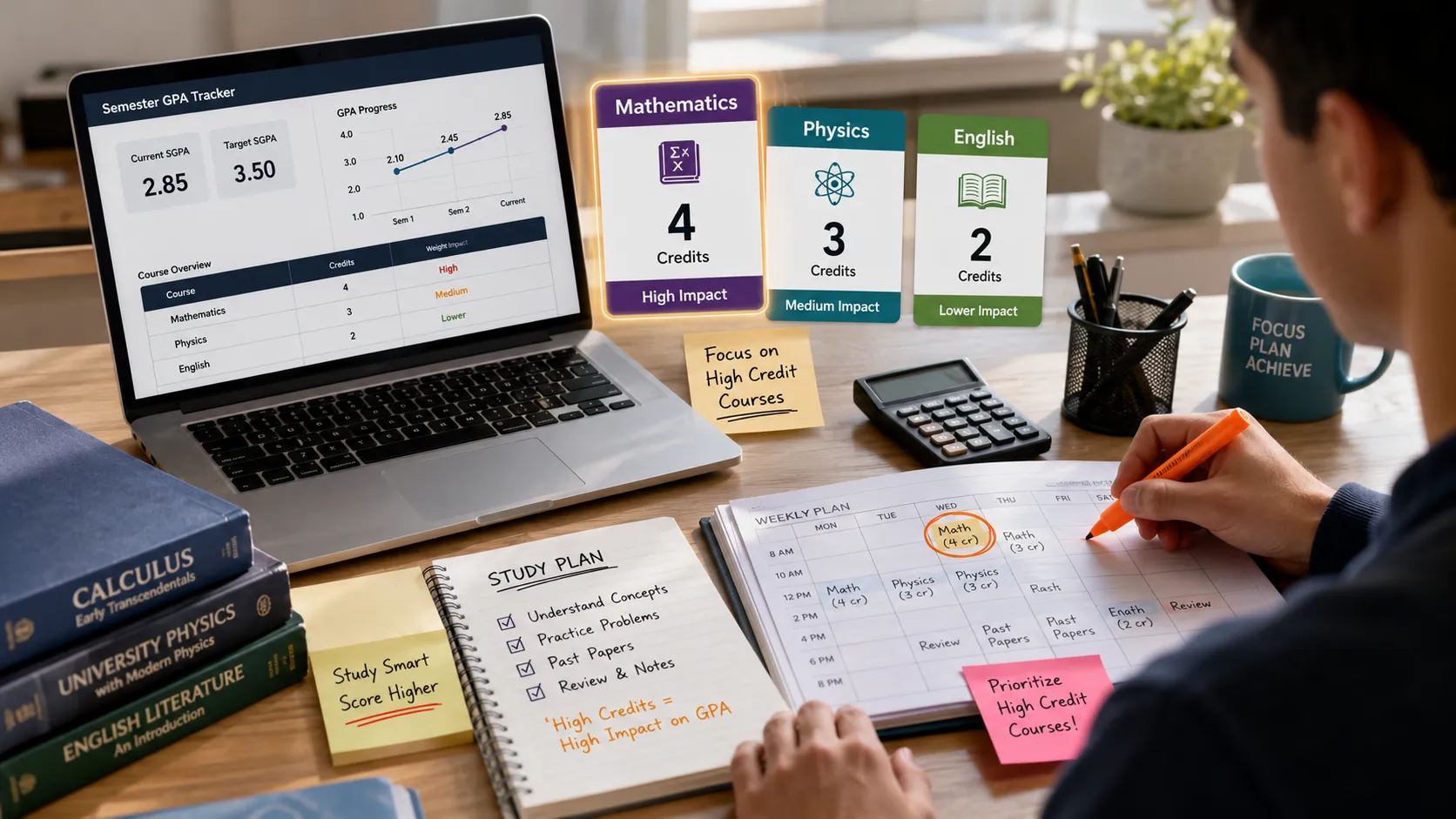
- High-credit courses deserve proportionally more study time — a 4-credit exam is mathematically twice as important as a 2-credit one.
- Office hours are the most underused resource in university — visit within the first two weeks, not after a failed midterm.
- Sleep is not optional. Memory consolidation happens during sleep; all-nighters reliably reduce exam performance.
- A 0.1 improvement in SGPA, sustained over four semesters, can move your final CGPA by a full grade point.
Why Most Study Habits Don't Work
There is a reason many diligent students work hard and still don't see the grades they expect. The issue is rarely effort — it is the type of effort. Passive studying creates the feeling of familiarity without actual knowledge retention. You re-read a chapter and recognize the words. You feel like you know the material. Then you sit in the exam and discover you cannot produce the information under pressure.
High-performing students are not necessarily smarter. They typically use fundamentally different study methods, approach their academic schedule with professional discipline, and make data-driven decisions about where to invest their time. These ten strategies are drawn from that difference.
1. Replace Passive Reading With Active Recall
Why It Works
Active recall is the practice of forcing your brain to retrieve information from memory without looking at your notes or textbook. Research consistently shows that this retrieval effort — even when difficult — dramatically strengthens long-term memory retention compared to re-reading. Resources like Khan Academy are built on this principle of active, practice-based learning.
How to Do It
After reading a textbook chapter or attending a lecture, close your materials. On a blank page, write down everything you can remember from that session. Include definitions, formulas, key arguments, and examples. The gaps that appear when you try to recall — the places where your mind goes blank — are precisely where you need to study more.
This technique, sometimes called the "blank page method," exposes genuine knowledge gaps in real time, which is far more valuable than the false confidence that comes from recognizing material while reading it passively.
Practical tools that use active recall: Anki (spaced repetition flashcards), past exam papers (practice under exam conditions), the Cornell Note-Taking System (built-in recall column for self-testing).
2. Track Your Grades Weekly — Not Just at Finals
Why Waiting Until Finals Is Dangerous
Most students only check their overall standing when final grades are posted. By then, every opportunity to correct course has passed. Tracking your academic standing every single week throughout the semester gives you the one thing that matters most: time to respond.
How to Set Up a Tracking System
Use our free CGPA Calculator to model your standing in real time. Alternatively, keep a simple running document:
- Column 1: Assignment or exam name
- Column 2: Weight in course grade (%)
- Column 3: Your score
- Column 4: Running weighted average
Update this after every graded item is returned. If your weighted average in Chemistry dips from a B+ to a B- after the midterm, you know immediately that you need to recalibrate your study approach for that course — three months before final grades are submitted.
3. Prioritize Based on Credit Weight
The Mathematical Reality
Not all courses contribute equally to your GPA. A 4-credit lecture course is worth exactly twice the GPA impact of a 2-credit lab. If you spend equal time studying for both, you are mathematically misallocating your effort.
How to Apply This
At the start of every semester, list your courses by credit hour value from highest to lowest. This is your priority stack. When a conflict arises — you have a lab report due and a major exam the same week — default to investing additional time in the higher-credit commitment. During crunch periods, reduce time on lower-credit courses to protect your standing in the ones that have the most mathematical leverage.
This is not about neglecting courses. It is about allocating your finite time and cognitive energy intelligently.
4. Go to Office Hours Before You Need To
The Wrong Way Students Use Office Hours
The majority of students who visit professor office hours do so for one reason: they just failed something and they're hoping the professor will help them recover. This reactive approach is far less effective than visiting proactively.
The Right Approach
Visit every professor's office hours in week two or three of the semester. Ask one thoughtful question about the course material or the syllabus. Introduce yourself briefly. Your goal is simple: to be a recognizable face who has demonstrated genuine engagement.
Why does this matter? Professors have discretion when borderline grades are involved. When an 89.4% sits at the A- boundary, a professor who has seen you at office hours, watched you engage with the material, and received evidence of your effort is significantly more likely to round up. A student whose name they cannot place is far less likely to receive that benefit of the doubt.
5. Use the Spaced Repetition Schedule
The Forgetting Curve
Research on memory shows that we forget approximately 70% of new information within 24 hours if we don't review it. By the time a typical student re-reads their notes before an exam two weeks later, most of the information has decayed significantly.
The Spaced Repetition Solution
Spaced repetition schedules your review sessions at increasing intervals to reinforce memories just before they decay:
- First review: 24 hours after the original lecture
- Second review: 3 days later
- Third review: 7 days later
- Fourth review: 21 days later
By the time an exam arrives, you have reviewed the material multiple times at strategically spaced intervals. The information is deeply encoded rather than freshly crammed.
The free flashcard tool Anki automates this scheduling entirely. You input your course material as flashcards, and the algorithm determines the optimal time to show each card based on your previous recall performance. Many pre-med and law students report this as their single most impactful academic tool.
6. Build a "Mastermind" Study Group
Why Studying Together Works
Explaining a concept to another person is one of the most effective ways to identify holes in your own understanding. When you can verbally explain the mechanism of enzyme inhibition or prove a mathematical theorem to a peer — without looking at your notes — you have genuinely mastered it.
How to Find the Right Group
Form a group of two to four people who are genuinely committed to academic performance in the same course. Size matters: groups larger than five frequently turn into social gatherings rather than study sessions.
The most effective format: Each person is assigned a section to teach the others during each session. Rotate the teaching responsibility so everyone develops deep ownership of every topic. After each teaching segment, the group asks challenging questions. This peer pressure to actually understand the material — rather than just recognizing it — produces significantly higher exam performance.
7. Apply the 2-Minute Rule to Academic Admin
What It Is
If an academic task takes less than two minutes to complete, do it immediately when you think of it.
This applies to: responding to a group project email, printing a required reading article, creating a folder for a new assignment, posting a question in the course forum, or booking an appointment with your academic advisor.
Why It Matters for GPA
These small tasks seem trivial but they accumulate. Students who constantly defer minor administrative items find their mental workspace cluttered with incomplete loops — small open tasks that occupy background cognitive processing. Clearing them immediately keeps your attention available for deep, sustained study sessions.
8. Design a Semester Calendar From Day One
The Syllabus Mining Method
On the first day of every class, take your syllabus and enter every assignment, quiz, midterm, and final exam into a single master calendar. This includes the weight of each assessment.
With the full semester mapped visually, you can see in advance where your workload clusters — the weeks where three midterms fall simultaneously, or where you have back-to-back project deadlines. Planning around these clusters, rather than discovering them in real time, gives you weeks of advance preparation.
Use Google Calendar (color-coded by course), Notion, or a paper planner — whatever system you will actually use. The tool does not matter; the discipline does.
9. Understand Your Exact Grading Position at All Times
For International Students
If you are studying in a different country from where you completed your secondary education, the grading scale you grew up with is not the same one your current university uses. An 80% in the UK context is genuinely excellent; an 80% in a standard US context is a B-.
Understanding exactly what your current grades mean on the scale that matters — and what you need to hit the specific letter grade boundaries — is essential for goal-setting. Use our Percentage to GPA Converter to clarify how your current percentage standing translates to the GPA scale your transcript uses.
Knowing Your Grade Boundaries
For every course, know the exact percentage cutoffs for each letter grade. Your grade boundary is the most valuable piece of data in your semester. If you are at 79.2% in a course where the B+ boundary is 80%, you know that a single focused study session before the next quiz might move you into a meaningfully better grade.
10. Protect Your Sleep — Especially During Finals
The Research Is Clear
Sleep deprivation impairs the prefrontal cortex — the area of the brain responsible for problem-solving, abstract reasoning, and working memory. These are precisely the cognitive functions that determine exam performance. A student who sleeps 7 hours after studying 80% of the material outperforms a student who pulls an all-nighter to study 100% of it.
During sleep, particularly in the deep sleep and REM stages, the brain consolidates short-term memories into long-term storage. If you skip sleep to cram, you bypass the consolidation process. The information you studied exists in temporary working memory — and under exam pressure, working memory under stress retrieves information unreliably.
The Practical Rule
For every exam, stop studying by 11 PM the night before. Spend those final hours reviewing your self-made notes, not consuming new material. Get seven to eight hours of sleep. You will access the information you studied far more reliably the next morning than you would after a sleep-deprived night of anxious re-reading.
Building the Habits: A Week-One Checklist
Before your first week of classes ends, complete these actions:
- [ ] Create a master semester calendar with all deadlines
- ] Set up a grade-tracking spreadsheet or use our [CGPA Calculator
- [ ] Identify your two highest-credit courses — these are your priority protection
- [ ] Schedule a first office hours visit for your most challenging course
- [ ] Download Anki or a similar spaced repetition tool
- [ ] Identify two or three potential study group partners in each challenging course
Frequently Asked Questions (FAQ)
How long should a study session be?
Research on cognitive performance suggests that focused study sessions of 45 to 90 minutes with 10-to-15-minute breaks produce better long-term retention than marathon sessions. The Pomodoro Technique (25 minutes focused, 5 minutes break) is a popular implementation for shorter attention spans.
Is it worth taking easier electives to protect my GPA?
Yes, strategically. Electives with high expected grade distributions can support your overall GPA while you focus your effort on difficult core requirements. Be honest about your bandwidth and select electives accordingly — not because you are avoiding challenge, but because sustainable academic performance matters more than an overloaded semester with mediocre results across the board.
Should I withdraw from a difficult course to save my SGPA?
If you are mathematically headed for a D or F and the withdrawal deadline has not passed, a W (withdrawal) on your transcript is almost always preferable to an F in your GPA calculation. A single F in a 3-credit course at 0.0 quality points can move your SGPA from a 3.4 to a 2.6.
Do extracurricular activities hurt my GPA?
They hurt your GPA if they consume study time without providing a proportional benefit. Leadership roles in clubs, research positions, and relevant internships can enhance your application in ways that offset a slightly lower GPA. The decision depends on whether the activity is genuinely building your profile or simply draining time you cannot spare.
Summary
Improving your semester GPA is a systems problem, not a willpower problem. The students who consistently earn the highest grades are applying a small number of fundamentally effective strategies — active recall, weekly grade monitoring, credit-weighted prioritization, and early professor relationships — more consistently than their peers.
Pick three of these strategies to implement before the end of week one. Lock them in as habits before the academic pace of the semester accelerates. The improvements you make in weeks two through five have far more impact than anything you can do in week thirteen.
Track your progress using our CGPA Calculator to see the effect of each semester's performance on your cumulative average. For guidance on what CGPA score you ultimately need for your career or graduate school goals, read our guide on What is a Good CGPA for a Master's Abroad?.