Quick Answer:
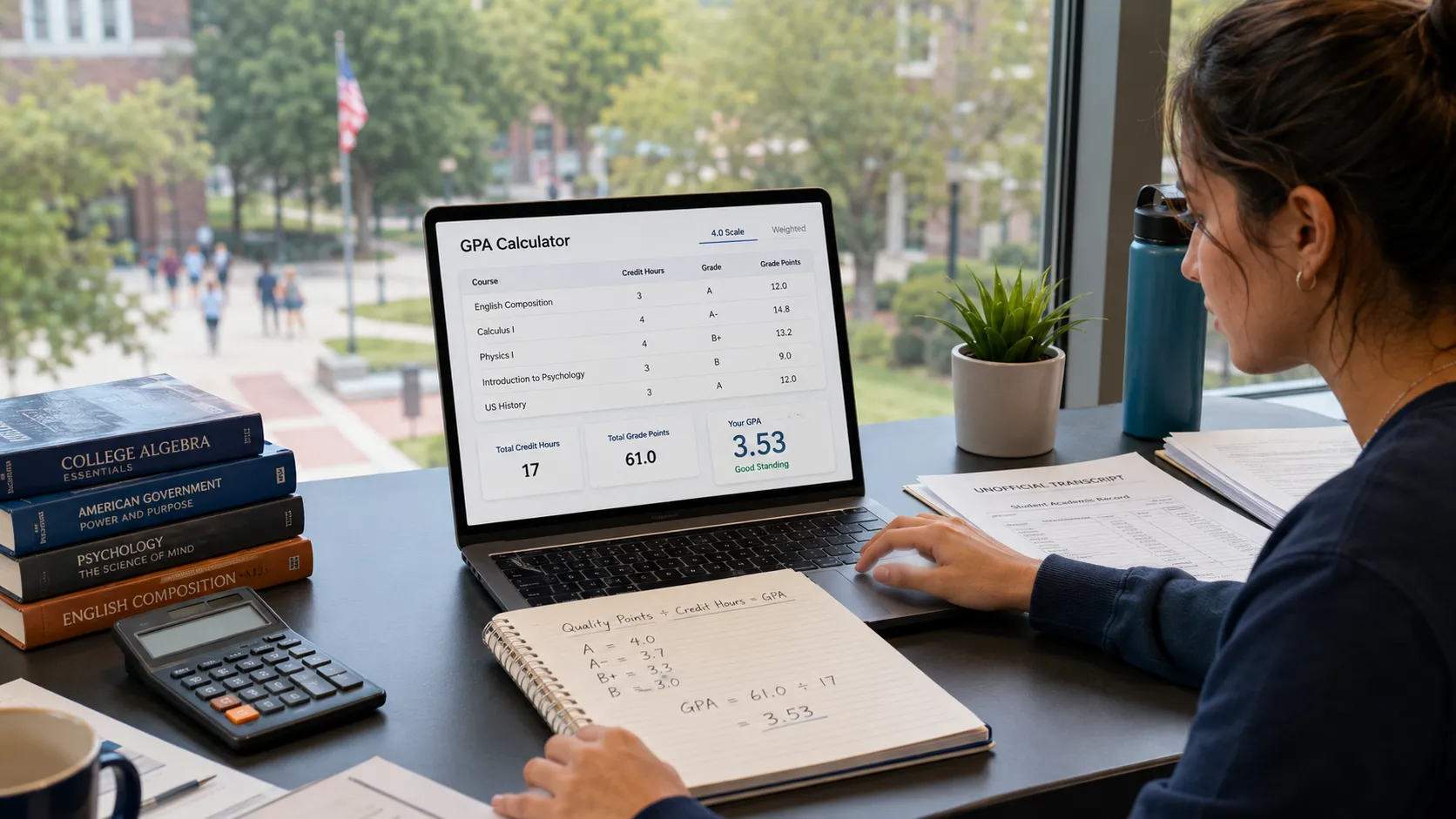
To calculate your GPA in the USA, convert each letter grade to its grade point value (A = 4.0, B = 3.0, C = 2.0, D = 1.0, F = 0.0). Multiply each grade point by the course's credit hours to get "Quality Points." Divide your total Quality Points by your total Credit Hours. The result is your GPA on the standard 4.0 scale.
Key Takeaways
- The US uses an unweighted 4.0 GPA scale where letter grades map to specific numerical point values.
- Your GPA is credit-weighted — courses with more credit hours have a proportionally larger impact on your average.
- "Weighted" GPA (up to 5.0) is used by high schools for advanced classes; graduate programs always use the unweighted 4.0 scale.
- International students must never use simple arithmetic (like dividing by 25) to convert their percentage to a 4.0 GPA — the systems are structurally incompatible.
- For official US graduate school admissions, use WES (World Education Services) or another NACES-certified evaluator to convert your international grades officially.
Why the US GPA System Is Different
The American GPA system is one of the most globally recognized academic metrics — and one of the most frequently misunderstood by international students. Unlike systems in India that use a 10-point scale or the UK that uses degree classifications (First, 2:1, 2:2), the US system combines a letter grade with a numerical weight that is then averaged across all your courses.
What makes this system distinctive is the role of credit hours. Not every course counts equally. A major core requirement worth four credit hours has four times the impact on your GPA as a one-credit elective. This weighting system is designed to ensure your GPA reflects your performance in your most important courses.
Understanding this system fully — and being able to calculate your standing at any point during the semester — gives you the academic awareness to make informed decisions: when to push harder, when to seek help, and when a course withdrawal is the smarter choice.
The US 4.0 GPA Scale: The Complete Reference Table
Most American high schools and universities use the following unweighted conversion table:
| Percentage Range | Letter Grade | GPA Points |
|---|---|---|
| 93% – 100% | A | 4.0 |
| 90% – 92% | A- | 3.7 |
| 87% – 89% | B+ | 3.3 |
| 83% – 86% | B | 3.0 |
| 80% – 82% | B- | 2.7 |
| 77% – 79% | C+ | 2.3 |
| 73% – 76% | C | 2.0 |
| 70% – 72% | C- | 1.7 |
| 67% – 69% | D+ | 1.3 |
| 65% – 66% | D | 1.0 |
| Below 65% | F | 0.0 |
Note that specific percentage cutoffs vary slightly by institution. Some universities set the F threshold at 60%; others at 65%. Always verify against your institution's specific grading handbook. If your professor uses a curve or a non-standard grading policy, the letter grades they assign are what gets recorded on your transcript — not the raw percentage.
Unweighted vs. Weighted GPA: What's the Difference?
This distinction is primarily relevant for high school students applying to US undergraduate programs. For graduate school, only the unweighted 4.0 scale is used.
Unweighted GPA (0.0 – 4.0)
This is the standard version. It assigns the same point values to all courses regardless of difficulty. An A in an advanced chemistry class earns the same 4.0 points as an A in a basic arts elective.
Unweighted GPA is used universally in US university applications and by all graduate programs. When an employer or graduate school says "list your GPA," they want your unweighted cumulative 4.0 average.
Weighted GPA (0.0 – 5.0)
Weighted GPA rewards students for taking harder courses. Courses labeled as Honors, Advanced Placement (AP), or International Baccalaureate (IB) receive a bonus point allowance. The typical boost is:
| Course Level | A Value (Weighted) |
|---|---|
| Regular | 4.0 |
| Honors | 4.5 |
| AP / IB | 5.0 |
A student who takes 10 AP classes and earns straight A's could achieve a weighted GPA above 4.0 — even as high as 4.8 or 5.0. This system acknowledges that not all academic challenges are equal.
Key Point: If a college asks for your weighted GPA and your unweighted GPA, provide both. If they only ask for "your GPA" without specifying, provide your unweighted 4.0 GPA.
Step-by-Step GPA Calculation Guide
Let's walk through the full calculation process with a realistic semester example.
Step 1: List Your Courses, Credits, and Grades
| Course | Credit Hours | Letter Grade |
|---|---|---|
| Introduction to Biology | 4 | A- |
| Calculus I | 4 | B+ |
| English Composition | 3 | A |
| History of Art (Elective) | 3 | B |
| Physical Education | 1 | A |
Step 2: Convert Letter Grades to Grade Points
| Course | Credit Hours | Letter Grade | Grade Points |
|---|---|---|---|
| Introduction to Biology | 4 | A- | 3.7 |
| Calculus I | 4 | B+ | 3.3 |
| English Composition | 3 | A | 4.0 |
| History of Art | 3 | B | 3.0 |
| Physical Education | 1 | A | 4.0 |
Step 3: Calculate Quality Points for Each Course
Multiply Grade Points × Credit Hours:
| Course | Credit Hours | Grade Points | Quality Points |
|---|---|---|---|
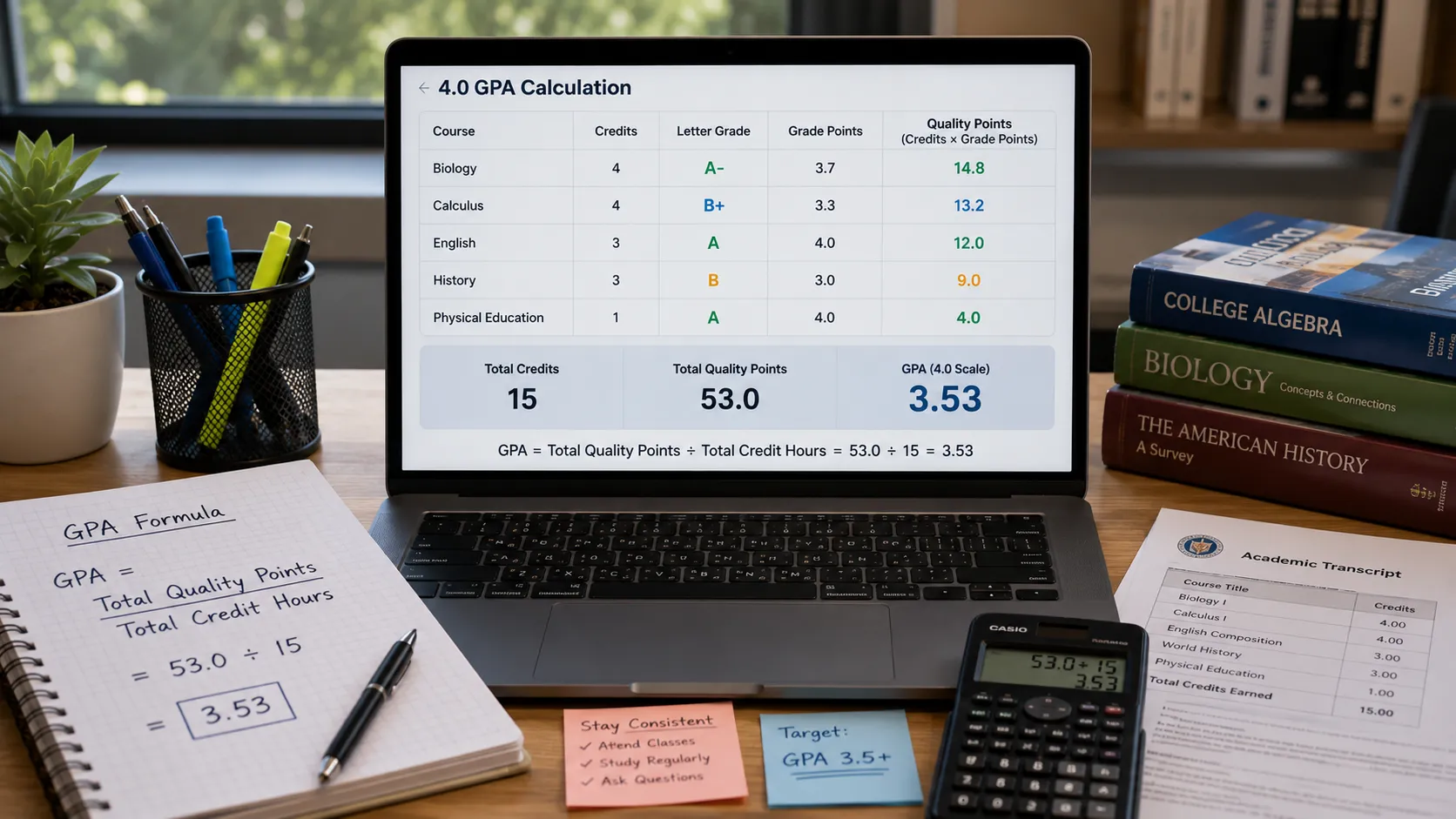
| Introduction to Biology | 4 | 3.7 | 14.8 |
| Calculus I | 4 | 3.3 | 13.2 |
| English Composition | 3 | 4.0 | 12.0 |
| History of Art | 3 | 3.0 | 9.0 |
| Physical Education | 1 | 4.0 | 4.0 |
| Totals | 15 | — | 53.0 |
Step 4: Divide Total Quality Points by Total Credit Hours
GPA = 53.0 ÷ 15 = 3.53
This student achieved a 3.53 GPA for this semester. Notice that the Physical Education elective (A, 4.0 points) only contributed 4 quality points despite a perfect grade, because it carries only 1 credit hour. Biology (A-, 3.7 points) contributed 14.8 quality points because it carries 4 credit hours. The weighting system correctly prioritizes core academic performance.
To skip this math entirely, use our free CGPA Calculator — enter your credits and grades for each semester and it calculates your GPA and cumulative CGPA instantly.
Cumulative GPA vs. Semester GPA
Your Semester GPA (called SGPA in many international systems) reflects only the term you just completed. Your Cumulative GPA (CGPA) is the weighted aggregate of all your semesters combined.
Both numbers appear on your transcript. Employers and graduate programs look at your Cumulative GPA. However, a strong upward trend in your semester GPAs — even if your cumulative number started low — can be mentioned favorably in a personal statement.
For a full breakdown of how semester-by-semester GPA contributes to your cumulative average, read our guide on GPA vs SGPA vs CGPA Explained.
How International Students Should Convert Their Grades
The Most Common Mistake
The single most damaging mistake an international student can make is using arithmetic division to convert their home country percentage to a US 4.0 GPA. You will find advice suggesting "divide by 25" or "multiply by 0.04." These formulas are structurally wrong.
Here is why: In the US, a 60% is a failing grade (F, 0.0 points). In India, 60% is a solid first-class pass. If you divide 60 by 25, you get 2.4 — presenting a failing grade as a C+. That misrepresentation can get an application disqualified if discovered.
The Correct Approach for US Applications
For informal use (resume, LinkedIn, initial screening):
Use region-specific bracket mapping. Our Percentage to GPA Converter applies established international conversion brackets based on your country of origin, giving you an accurate estimate you can cite in parentheses next to your original grade.
For formal applications (graduate school, official admissions):
Submit your official transcripts alongside a credential evaluation from a NACES-certified service:
- WES (World Education Services): The gold standard for US and Canadian applications, accepted at virtually every American university.
- ECE (Educational Credential Evaluators): Widely accepted, particularly strong for European credentials.
- SpanTran: Specializes in specific regional transcript evaluations.
These evaluators analyze your institution's historical grading patterns and produce a certified report that admissions committees trust without question.
What "Good" GPA Means at Different Levels
GPA benchmarks shift depending on the program and institution you are targeting:
| GPA Range | Typical Context |
|---|---|
| 3.8 – 4.0 | Top-tier programs (Ivy League, MIT, Stanford), highly competitive scholarships |
| 3.5 – 3.7 | Strong state universities, merit scholarships, most professional programs |
| 3.0 – 3.4 | Standard graduate school minimum, most mid-tier universities |
| 2.7 – 2.9 | Borderline for graduate admissions; strong GRE/GMAT scores needed |
| Below 2.5 | Most programs require an explanation; additional experience or test scores expected |
For a specific breakdown of what CGPA is needed for Master's programs abroad, read our guide on What is a Good CGPA for a Master's Abroad?.
GPA and Financial Aid: The Stakes
GPA is not just an academic credential in the US — it directly determines financial eligibility. Federal student aid (FAFSA-based) requires maintaining satisfactory academic progress, which typically means a cumulative GPA of at least 2.0. Many institutional scholarships have even higher requirements:
- Automatic scholarship renewal often requires a semester GPA of 3.0 or higher.
- Some merit awards require maintaining a 3.5 cumulative GPA every term.
- Research assistantships and teaching assistantships at the graduate level typically require a minimum 3.0 GPA.
Falling below a scholarship's GPA requirement mid-year does not necessarily mean immediate loss of the award — most institutions have an academic probation period where you can recover. But knowing your exact GPA at all times is essential to catching these situations early.
Frequently Asked Questions (FAQ)
What is a "good" GPA in the US?
For undergraduate programs, a 3.0 (B average) is generally considered good academic standing. For graduate admissions, competitive programs typically want 3.3 to 3.7. Elite programs and highly competitive PhD positions may expect 3.8 or higher.
Does retaking a class remove the old grade from my GPA?
It depends on your institution's grade forgiveness policy. Many US universities offer academic fresh start or grade forgiveness programs where a retaken course replaces the original grade in your GPA calculation. Always check your specific institution's registrar policy before retaking.
What is the maximum possible GPA on a 4.0 scale?
4.0 on an unweighted scale. Some universities formally assign 4.3 for an A+ (rather than 4.0), so technically a 4.0-scale institution can produce records slightly above 4.0 in those cases. Most cap at 4.0.
Do pass/fail courses affect my GPA?
No. Pass/fail courses (P/F on transcript) are excluded from GPA calculations. They count toward credit hour completion for graduation requirements, but do not contribute any quality points — positive or negative — to your cumulative GPA.
My university doesn't use credit hours — it uses a unit system. Is the calculation the same?
Yes. Whatever unit system your university uses to measure course weight, the calculation formula is identical: (Grade Points × Units) ÷ Total Units. The labels differ; the math is the same.
Summary
The US GPA system uses a credit-weighted calculation on a 4.0 scale, where each course's impact on your average is proportional to its credit hour value. The most important practical skills are: knowing the standard grade-to-point conversion table, understanding that courses with more credits carry more weight, and recognizing that cumulative GPA reflects your entire academic history, not just your most recent semester.
For international students, the key takeaway is to avoid simple arithmetic conversions. Use bracket-based methods or certified evaluators to ensure your home country grades are accurately represented on US applications.
Ready to calculate your own GPA right now? Use our free CGPA Calculator for an instant result. If you're trying to understand your CGPA relative to a Master's program requirement, read our guide on What is a Good CGPA for a Master's Abroad?.