Quick Answer:
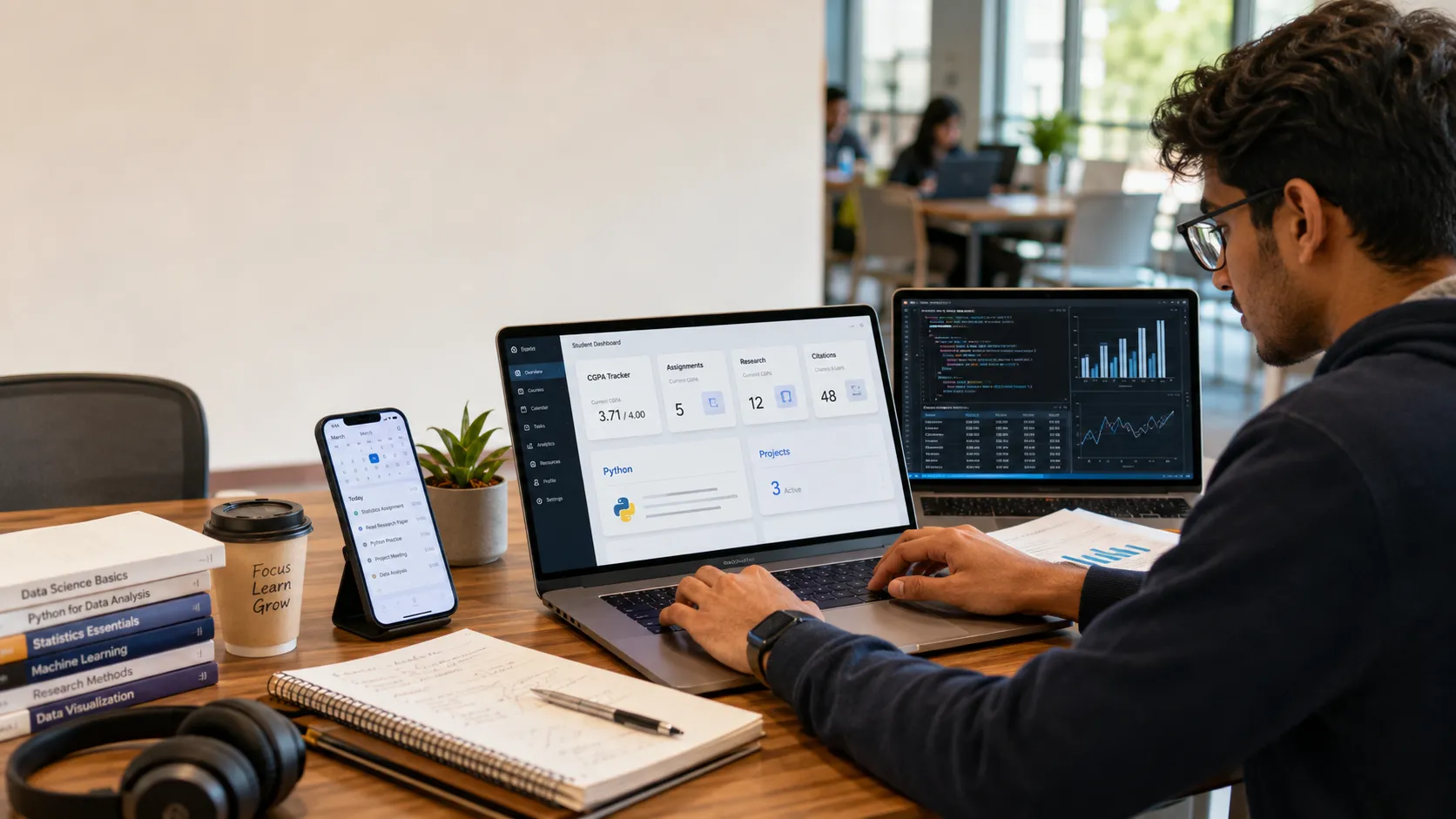
A student tech stack is a curated set of digital tools and technical skills that together make your academic life more efficient and your career profile more competitive. At its core: a GPA tracker for academic clarity, a reference manager for research efficiency, a project organizer for deadline management, and foundational Python skills for career differentiation. The combination replaces hours of busywork with focused learning time and prepares you for a job market that now expects data literacy across every industry.
Key Takeaways
- The goal of a student tech stack is not to use every available tool — it is to eliminate the specific friction points that waste your time and damage your grades.
- Academic productivity tools (grade calculators, reference managers, task planners) save two to five hours per week in administrative work when used consistently.
- Data literacy is no longer a "tech major" skill — employers across marketing, finance, HR, education, and healthcare now routinely list Python or SQL as preferred qualifications for non-technical roles.
- You do not need to become a software engineer to benefit from Python knowledge. The ability to clean a dataset, produce a chart, or automate a repetitive task is sufficient to stand out.
- Balancing external skill-building with academic performance requires discipline — tracking your CGPA regularly ensures extracurricular upskilling does not cost you your GPA.
Why Technical Skills Are No Longer Optional
There was a time when technical skills were neatly siloed. Software engineers coded. Marketing teams wrote copy. Accountants ran spreadsheets. The idea that a marketing analyst or an HR professional would need to know Python was genuinely unusual.
That era is over. Modern companies generate data from every interaction — customer behavior, sales patterns, employee performance, supply chain movements — and they need people at every level who can work with that data. The demand for professionals who combine domain expertise with technical literacy has created a talent gap that remains largely unfilled.
For university students, this creates a significant opportunity. Learning foundational data skills during your undergraduate years costs nothing but time, and the return in starting salary, career trajectory, and interview success is measurable. Python.org is the official starting point — free, beginner-friendly documentation and a massive community mean you can go from zero to productive in a single semester with consistent practice. This guide covers both the academic tools that protect your GPA and the technical skills that differentiate your resume.
Part 1: The Academic Tech Stack
Tool Category 1: Grade Tracking
The starting point for any academic tech stack is knowing exactly where you stand at all times. Waiting for your university registrar to post final grades before checking your standing is the academic equivalent of not checking your bank account balance.
EduGPA CGPA Calculator
Our free CGPA Calculator lets you enter your credit hours and SGPA for each semester and instantly calculates your cumulative GPA. More importantly, it lets you run forward simulations: "If I score a 3.6 SGPA this semester with 15 credits, what will my final CGPA be?"
This transforms CGPA from an outcome into a variable you actively manage.
Percentage to GPA Converter
If your university grades in percentages and you need to present your GPA to international employers or graduate programs, our Percentage to GPA Converter provides an accurate bracket-based conversion rather than an inaccurate arithmetic estimate.
Tool Category 2: Organization and Task Management
Notion
Notion is the most flexible free organizational platform available for students. Think of it as a customizable workspace where you can:
- Track assignment deadlines with a Kanban board (To Do → In Progress → Submitted)
- Keep structured notes for every course (with a template that resets each semester)
- Build a master calendar showing every deadline across all courses
- Store research links, PDFs, and reading notes in an organized library
Notion offers a free plan for individuals and a free Personal Pro upgrade for students with a `.edu` email address. The latter removes page limits and adds collaborative features useful for group projects.
Google Calendar
For deadline management, color-coded Google Calendar entries for each course create an immediately visible picture of your week. Set events for every exam, paper deadline, and project submission day during week one of the semester. The weeks where three deadlines cluster will become visible immediately — giving you time to prepare in advance rather than discovering the cluster four days before it arrives.
Tool Category 3: Research and Citations
Zotero
Zotero is the most important free tool for any student writing research papers. It is a reference manager that integrates with your browser and word processor.
When you find an academic paper on Google Scholar or a university database, one click of the Zotero browser extension saves the full reference (author, title, journal, date, DOI). In Microsoft Word or Google Docs, insert in-text citations from your Zotero library with one click, and generate a complete, perfectly formatted bibliography in APA, MLA, Chicago, or any other style your course requires.
The manual alternative — formatting citations for a 15-source paper by hand — takes two to three hours. Zotero completes it in under a minute. Over a full semester of research papers, this saves eight to twelve hours of mechanical formatting work.
Google Scholar
For finding sources, Google Scholar indexes millions of peer-reviewed papers, conference proceedings, theses, and academic books. Beyond basic search, use these features:
- "Cited by" links: Find newer papers that cite an older landmark study — essential for literature reviews
- Alerts: Set email notifications for new papers on specific keywords
- Free PDF access: Check the right-side icon for free full-text links before assuming a paper requires a paid subscription
Part 2: Future-Proofing With Data Science Skills
Why Data Science Matters Outside Technology Majors
The following roles now frequently list Python or data analysis skills in job descriptions, across non-technology industries:
| Industry | Role | Why Data Skills Are Needed |
|---|---|---|
| Marketing | Campaign analyst | A/B testing, customer segmentation, attribution modeling |
| Finance | Financial analyst | Automated reporting, risk modeling, portfolio analysis |
| Human Resources | People analytics | Retention prediction, recruitment funnel analysis |
| Healthcare | Clinical coordinator | Patient outcome tracking, EHR data interpretation |
| Education | Academic coordinator | Student performance analysis, enrollment trends |
| Journalism | Data journalist | Investigative data visualization, trend analysis |
A humanities or social science student who adds basic Python skills to their degree does not become a software engineer — they become someone who can contribute to data-driven decisions in any organization they join.
Why Python Specifically
Of the major programming languages, Python is the most appropriate starting point for students from non-technical backgrounds for three reasons:
1. Readable syntax: Python code reads almost like plain English. Variables are defined without complex type declarations. Functions are organized in logical blocks. The learning curve from zero to functional is gentler than Java, C++, or JavaScript.
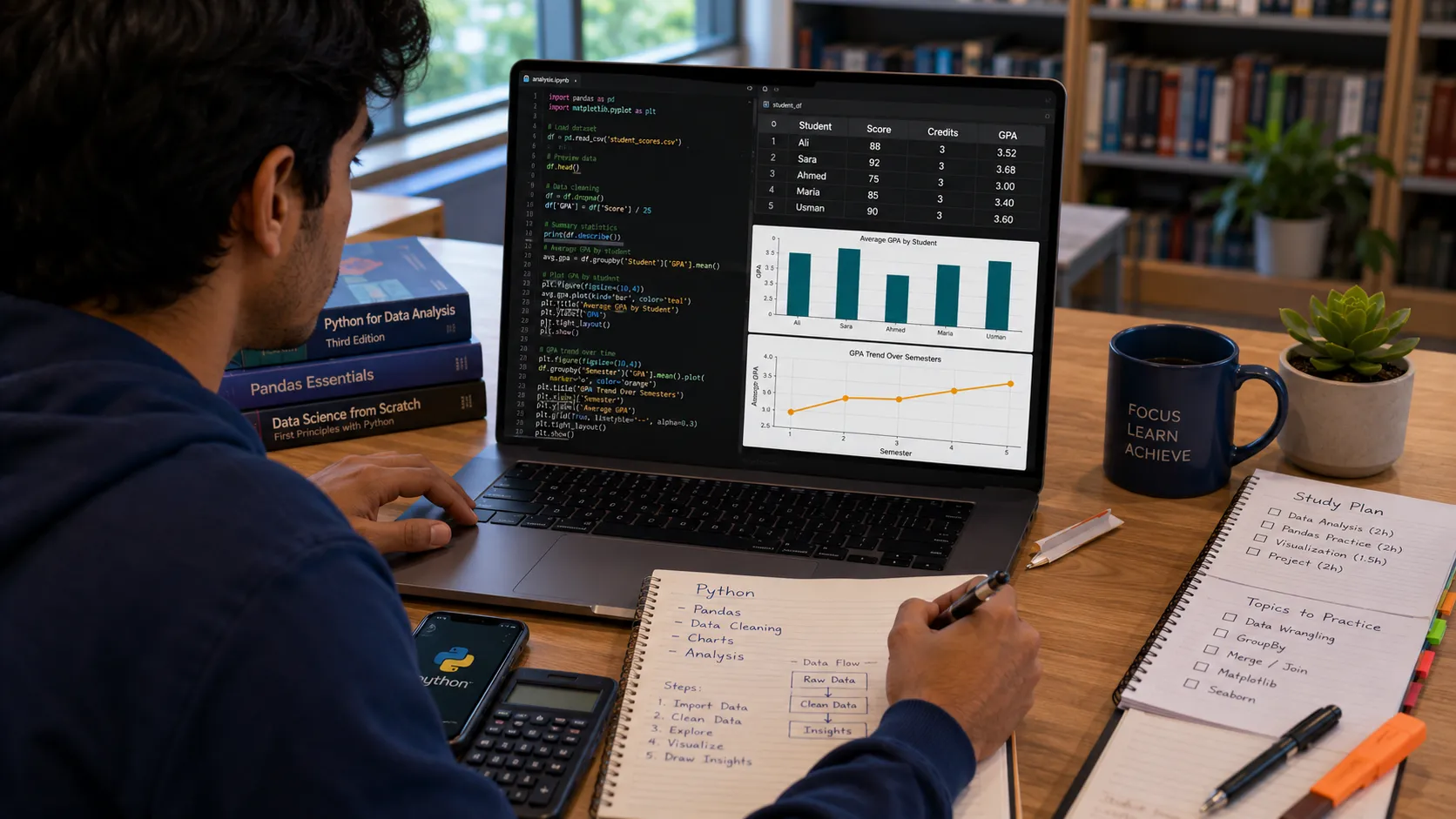
2. Library ecosystem: Python's data science ecosystem — primarily the libraries NumPy, Pandas, Matplotlib, and Seaborn — provides pre-built tools for data cleaning, analysis, and visualization. You do not need to write algorithms from scratch to do meaningful work.
3. Industry adoption: Python is the dominant language in data science, machine learning, and automation. Learning it connects you to the largest community of practitioners, the most job postings, and the most available learning resources of any language.
What "Functional Python Skills" Looks Like in Practice
You do not need to build machine learning models or write production software to gain a career advantage from Python. These are the core competencies that differentiate non-technical graduates:
- Data loading and cleaning with Pandas: Read a CSV file, remove duplicates, handle missing values, filter rows by condition
- Descriptive statistics: Calculate mean, median, standard deviation, and correlation coefficients on real datasets
- Basic visualization with Matplotlib: Create bar charts, line plots, and scatter plots to present findings clearly
- Automation of repetitive tasks: Write a script that renames 200 files, converts a folder of CSVs into one merged spreadsheet, or sends a weekly email summary
These four skills take approximately 40 to 80 hours of structured learning to develop competently. That is a realistic investment across a single semester for any student willing to dedicate five to eight hours per week.
Where to Learn Python for Free or Low Cost
| Platform | Course | Cost |
|---|---|---|
| Coursera (Python for Everybody — University of Michigan) | Beginner to intermediate Python | Free to audit |
| edX (Python for Data Science — MIT) | Data science focus | Free to audit |
| DataCamp | Interactive, browser-based Python | Free first chapters, discounted student plan |
| Kaggle Learn | Pandas and data visualization | Completely free |
| CS50P (Harvard OpenCourseWare) | Programming with Python | Completely free |
Kaggle Learn's Python and Pandas courses are particularly effective for students who want to focus exclusively on data work without covering general programming concepts.
Part 3: Balancing the Stack Without Sacrificing Your GPA
This is where many ambitious students make a significant mistake. They enroll in an online bootcamp, dedicate 15 hours per week to learning Python, and discover at midterm that their academic grades have suffered visibly.
Technical skill-building is a long-term investment. Your GPA is an immediate credential. If a 0.5 CGPA drop costs you a graduate school application or a campus placement opportunity, the trade-off is not worth it.
The Rule for Balancing Upskilling and Academics
Treat external skill-building (online courses, certifications, personal projects) as a fixed weekly budget — ideally four to six hours per week during the academic semester, not fifteen. Reserve intensive learning phases for university breaks (summer, winter recess) when your academic workload is minimal.
Track your CGPA every month during upskilling phases using our CGPA Calculator. If your semester GPA is tracking below your target, reduce your external learning hours immediately. The technical skills will still be available to learn after exams.
What to Add to Your Resume
Once you have built functional Python skills through a structured course, add this to your resume in the Skills section:
- Programming Languages: Python (Pandas, Matplotlib, NumPy)
- Data Tools: Microsoft Excel, Google Sheets, SQL (beginner)
- Academic Tools: Zotero, Notion, Google Workspace
Include a brief portfolio if possible — even a single Jupyter Notebook analysis of a public dataset (from Kaggle or government open data portals) demonstrates applied competence in a way that a certification alone cannot.
Frequently Asked Questions (FAQ)
Do I need a computer science background to learn Python?
No. The most popular Python data science courses are explicitly designed for absolute beginners with no programming background. Many practicing data analysts and data journalists learned Python entirely through self-study during or after completing a non-technical degree.
Is free Python learning enough, or do I need a paid bootcamp?
For foundational skills, free resources are fully sufficient. Coursera's "Python for Everybody" and Kaggle Learn cover everything you need to be job-ready in basic data tasks. Paid bootcamps are worth considering if you need structured accountability or a career placement guarantee.
How do I prove Python skills to employers without professional experience?
Create two or three data analysis projects using publicly available datasets (Kaggle, World Bank, government open data portals). Upload these as Jupyter Notebooks to a GitHub profile. A GitHub link showing real data work is far more persuasive to hiring managers than a certificate PDF.
How long does it take to become job-ready with Python?
For basic data analysis skills (Pandas, Matplotlib, descriptive statistics), 40 to 80 hours of structured learning produces functional competence. For more advanced skills (machine learning, statistical modeling), expect 6 to 12 months of consistent practice.
Summary
The combination of strong academic management tools and foundational data skills creates a profile that is rare among recent graduates — someone who can perform well in structured academic environments and contribute to data-driven work in modern organizations.
Start your tech stack with the tools that protect your academic foundation: track your GPA consistently with our CGPA Calculator, manage your research with Zotero, and organize your deadlines with Notion. Once those habits are stable, invest four to six hours per week in Python skills through free platforms like Kaggle Learn or Coursera.
The return on both investments compounds. A strong CGPA keeps your options open. Data skills multiply what you can do with those options.
For a deeper look at the full range of free academic tools available to students, read our complete guide on Best Free Academic Tools for Students in 2026.