Quick Answer:
Yes, you can improve your CGPA in your final year — but the mathematics make large jumps nearly impossible. By the time you reach your senior year, 75–80% of your degree credits are already locked in. Even a perfect final year SGPA of 4.0 may only move your cumulative CGPA by 0.2 to 0.4 points. The goal should not be a dramatic rescue — it should be strategic, targeted improvement to cross specific cutoff thresholds that matter for graduate school or employment.
Key Takeaways
- Your final year credits carry far less mathematical weight on your CGPA than your early university years — the formula makes this inevitable, not a failure of effort.
- Grade replacement policies (where retaking a failed course removes the F from your GPA) are the single fastest route to CGPA improvement.
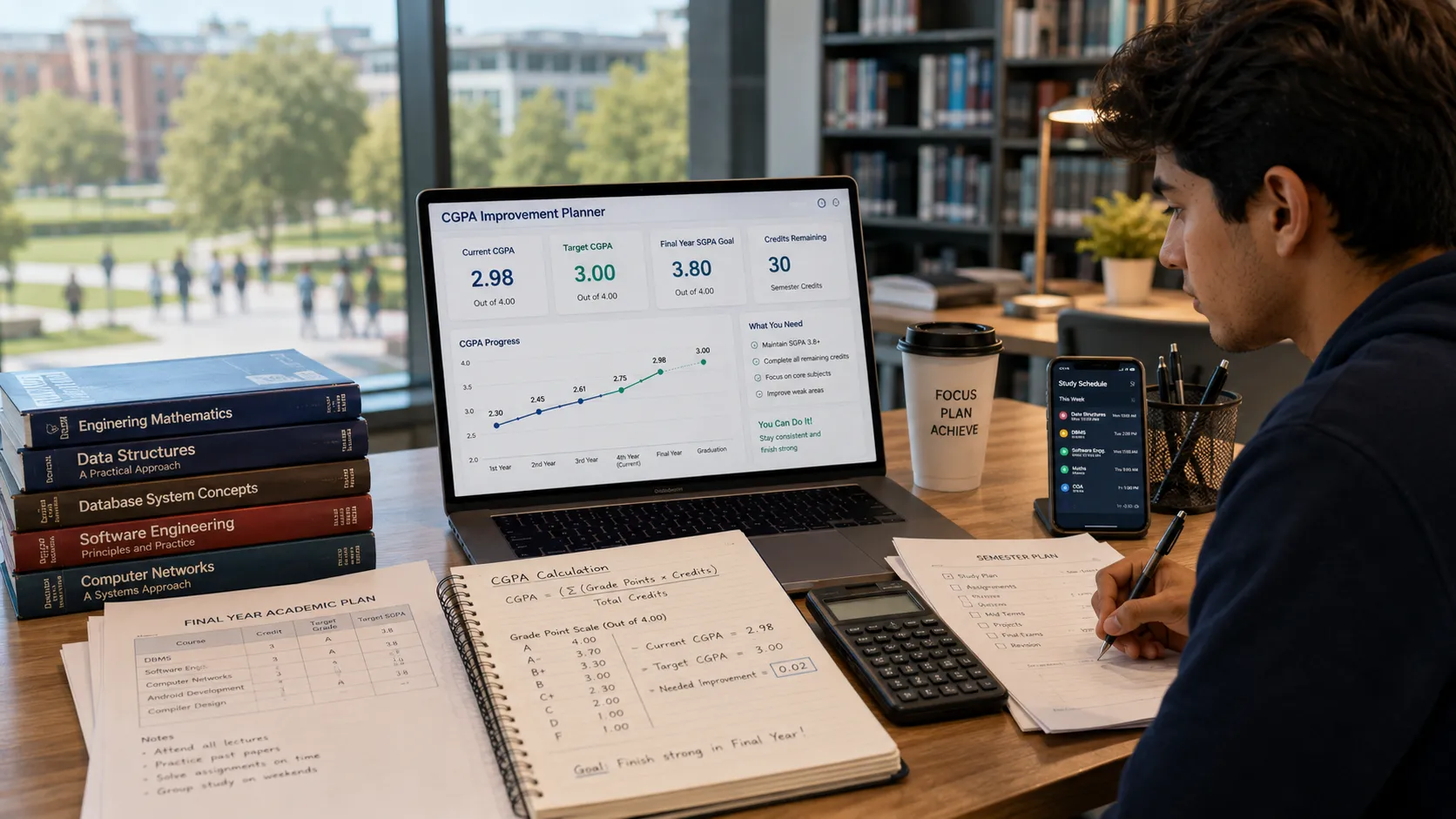
- Pushing your CGPA from 2.98 to 3.01 may seem small, but it moves you past the automated screening cutoffs used by most employers and graduate programs.
- If your overall CGPA is mathematically stuck, shift attention to your Major GPA and your Last-60-Credits GPA — both are meaningful alternatives for many applications.
- A strong final year SGPA tells a compelling story of improvement, even if the cumulative number barely shifts.

The Reality Check Every Final-Year Student Needs
The panic sets in late — usually around the beginning of your senior fall semester. You start looking at graduate school requirements, reading job postings that specify a 3.0+ GPA, and comparing your transcript to what you see. And if your number falls below where you need it to be, the question is immediate: Can I still fix this?
Let's be direct: you cannot erase three years of grades in one year. That is not a motivational failure — it is arithmetic. But the more important question is not whether you can make a dramatic leap. It is whether you can cross the specific threshold you need, even by a fraction. And the answer to that question, for most students, is often yes — with the right strategy.
The Math: Why Senior Year Has Limited Leverage
Your CGPA is a weighted average. As you accumulate more credit hours over your degree, each new semester contributes a proportionally smaller share to the overall number.
A Concrete Illustration
Suppose you are entering your final year with 90 accumulated credit hours and a 2.8 CGPA. You are taking 30 credits in your final year.
Even if you earn a perfect 4.0 SGPA for your entire final year, here is what happens:
| Credits | GPA | Quality Points | |
|---|---|---|---|
| Previous 3 Years | 90 | 2.8 | 252 |
| Final Year (Perfect) | 30 | 4.0 | 120 |
| Combined | 120 | — | 372 |
New CGPA = 372 ÷ 120 = 3.10
A flawless senior year moved the CGPA from 2.8 to 3.10. That is a 0.30 improvement from a full year of perfect performance. It is meaningful — but it is not a transformation.
This is why CGPA recovery strategies must be surgical. The goal is not a complete reinvention; it is strategic targeting of the numbers that matter most.
Strategy 1: Understand the Thresholds You Actually Need to Cross
Before doing anything else, identify the exact CGPA numbers that matter for your specific goals. These thresholds are not arbitrary.
| Context | Typical CGPA Cutoff |
|---|---|
| Most graduate school programs (US/Canada) | 3.0 on a 4.0 scale |
| Top-tier US graduate programs (MIT, Stanford, Ivy) | 3.5 – 3.7 |
| Large corporate grad schemes (India) | 7.5 / 10 |
| Most campus placements in India | 6.5 – 7.5 / 10 |
| UK Master's programs (Russell Group) | Upper Second (2:1) |
| Financial services (many investment banks) | 3.5+ or First Class |
Automated applicant tracking systems (ATS) used by large employers filter applications at exact cutoffs. A 2.98 CGPA is functionally invisible to a system requiring 3.0. That 0.02 gap costs you an interview. Closing it should be your primary focus — not chasing a 3.5.
Use our CGPA Calculator to model what SGPA you need in your remaining semesters to cross your target threshold. The calculator shows you exactly what is possible mathematically, so you can plan with precision rather than hope.
Strategy 2: Grade Replacement — The Fastest CGPA Boost Available
What It Is
Many universities offer a grade forgiveness or grade replacement policy. Under this policy, if you retake a course you previously performed poorly in (especially one where you earned an F or D), the new grade replaces the old one in your GPA calculation.
This is fundamentally different from simply adding new credits to dilute old ones. Grade replacement actively removes the damage from your GPA formula.
Why It Is Powerful
If you received an F (0.0) in a 3-credit course in your sophomore year and you retake it as a senior and earn an A (4.0), grade replacement changes your quality point total dramatically:
Without replacement:
- Your quality points include 0.0 × 3 = 0 quality points for that course
With replacement:
- Your quality points include 4.0 × 3 = 12 quality points for that course
That single grade swap adds 12 quality points to your record — equivalent to taking an additional 3-credit course and scoring a perfect A on top of your normal workload.
How to Access Grade Replacement
Talk to your academic advisor in the first week of your senior year. Ask specifically:
1. Does our university have a grade forgiveness or replacement policy?
2. How many courses can I replace?
3. Does the original grade remain visible on my transcript, or is it removed entirely?
4. Are there restrictions on which courses qualify?
Policies vary significantly. Some institutions allow unlimited replacements; others cap it at three courses. Some remove the old grade entirely; others leave it on the transcript but exclude it from the GPA calculation. Understanding the specifics at your school is essential before making enrollment decisions.
Strategy 3: Optimize Your Course Selection
Take High-Credit Courses Seriously (And Strategically)
In your final year, you may have room in your schedule for open electives. Every elective slot is a GPA opportunity.
A 4-credit elective where you earn an A contributes 16 quality points. A 2-credit elective at the same grade contributes only 8. When selecting electives, factor in both your genuine interest in the subject and its credit value. Choosing high-credit courses in areas where you are confident creates maximum GPA leverage.
Avoid Course Overload
A common mistake is taking 21 or more credits in your final semester to "make up" for lost ground — loading up on courses to create more GPA opportunities. This almost always backfires. Distributing your attention across seven courses means no single course receives the focused effort that earning an A demands. A more strategic 15-credit semester with four strong grades produces better results than an overloaded schedule with mediocre performance across seven courses.
Capstone and Thesis Projects
Many senior programs include a capstone project or undergraduate thesis. These are often worth 4 to 6 credits and graded on research quality, presentation, and methodology. If your program offers a thesis track, consider it seriously. Students who genuinely engage with their research typically earn strong marks because the evaluation is holistic — effort, process, and genuine intellectual engagement are rewarded, not just memorization.
Strategy 4: Maximum Effort on Every Grade Boundary
The Boundary Principle
Letter grade boundaries are where your effort has the highest ROI. Moving from 89% to 91% in a class changes your grade from a B+ (3.3) to an A- (3.7). That 0.4 grade point difference, multiplied across a 4-credit course, is 1.6 quality points — a meaningful contribution to your CGPA.
Identify in every class whether you are sitting near a grade boundary. If you are at 87% midway through the semester and the A- boundary is 90%, three focused extra sessions of targeted studying might move you above the threshold. If you are comfortably at 85%, the same effort might be better invested in a different class where you are closer to a grade boundary.
Go to Office Hours — Before You Need To
Visit every professor's office hours in the first two weeks of each course. This is not about seeking special treatment. It is about being known as an engaged, serious student. Professors have discretion when rounding borderline grades. A student they recognize as hardworking and present is far more likely to receive that rounding than a name they cannot place.
Strategy 5: When the CGPA Number Is Locked In
Sometimes the math is clear: no realistic senior year performance will move your CGPA past the cutoff you need for your goal. When that is the case, the most effective strategy is not to chase the number — it is to change the narrative.
Highlight Your Major GPA
Your Major GPA is calculated using only the courses directly required for your specific degree — core major requirements only, excluding general education electives. If your low CGPA results from struggling in mandatory Freshman Composition while excelling in your Computer Science major courses, your Major GPA will tell a significantly more flattering story.
Many employers and graduate programs accept Major GPA as a valid metric. List it explicitly on your resume alongside your overall CGPA (e.g., "Overall CGPA: 2.9 | CS Major GPA: 3.6").
Emphasize the Final-60-Credits GPA
The Last-60-Credits GPA (or equivalent — last two years of study) is how many Canadian universities evaluate international applicants, and it is cited favorably by many graduate programs in your Statement of Purpose.
If your CGPA was dragged down by a difficult freshman year and you have shown consistent improvement since then, your Last-60-Credits GPA is your strongest academic talking point. Calculate it, verify it, and present it prominently in applications to programs where it is considered.
Strategy 6: Build the Application Beyond the Transcript
If your CGPA is genuinely below competitive thresholds, your remaining senior year is also the best time to build the supplementary credentials that offset it:
- Research experience: Approach a professor in your field about assisting with their research. Even a semester of undergraduate research assistance, if you contribute genuinely, becomes a strong resume item and a source for a meaningful recommendation letter.
- Internships: A final-semester internship at a recognized company in your target industry provides practical experience that many employers value as highly as GPA for entry-level roles.
- Certifications and standardized tests: A strong GRE Quantitative score (160+) for graduate school, or an industry certification (AWS, Google Cloud, CFA Level 1), provides third-party validation of competence that complements a modest transcript.
Frequently Asked Questions (FAQ)
Can I delay graduation to take more classes and raise my CGPA?
It is rarely worth the financial cost unless you are a fraction of a point away from a strict cutoff for a program like medicine or law where the threshold is absolute. An extra semester of tuition typically costs more than its GPA benefit is worth for most career paths.
Do employers actually verify my CGPA?
Yes — large companies universally require an official transcript during the background check phase. Never round up or misrepresent your GPA on a resume. A verified discrepancy results in immediate offer rescission, and in some industries, permanent blacklisting from that employer.
Is a 3.0 CGPA "good enough" for most opportunities?
For the majority of general corporate roles and mid-tier graduate programs, a 3.0 (or 7.5/10) is the minimum that keeps your application in consideration. It is not a strong GPA, but it clears the automated filter in most systems. A strong resume and compelling cover letter can compete effectively from there.
How do I calculate my Major GPA?
Obtain a copy of your degree audit or transcript. Identify every course listed under your major requirements (not electives or general education). Plug those courses' grades and credit hours into a standard GPA calculator — or use our CGPA Calculator and enter only those courses.
Summary
Your final year is not a CGPA resurrection — it is a targeted optimization. The math limits how far you can move the overall number. But strategic grade replacement, focused effort on high-credit courses, and aggressive pursuit of grade boundaries can realistically push you past the automated thresholds that determine whether your applications are reviewed at all. For the official credit and grading framework that governs Indian universities, refer to the University Grants Commission (UGC) guidelines published on their official portal.
If the number is mathematically stuck, the work shifts to your narrative: Major GPA, Last-60-Credits GPA, research experience, and your Statement of Purpose. These tools exist precisely for students in your position.
Start with an accurate understanding of exactly where you stand. Use our CGPA Calculator to model different scenarios before finalizing your course enrollment. Then execute the plan that maximizes your outcomes with the time you have left.