
Quick Answer:
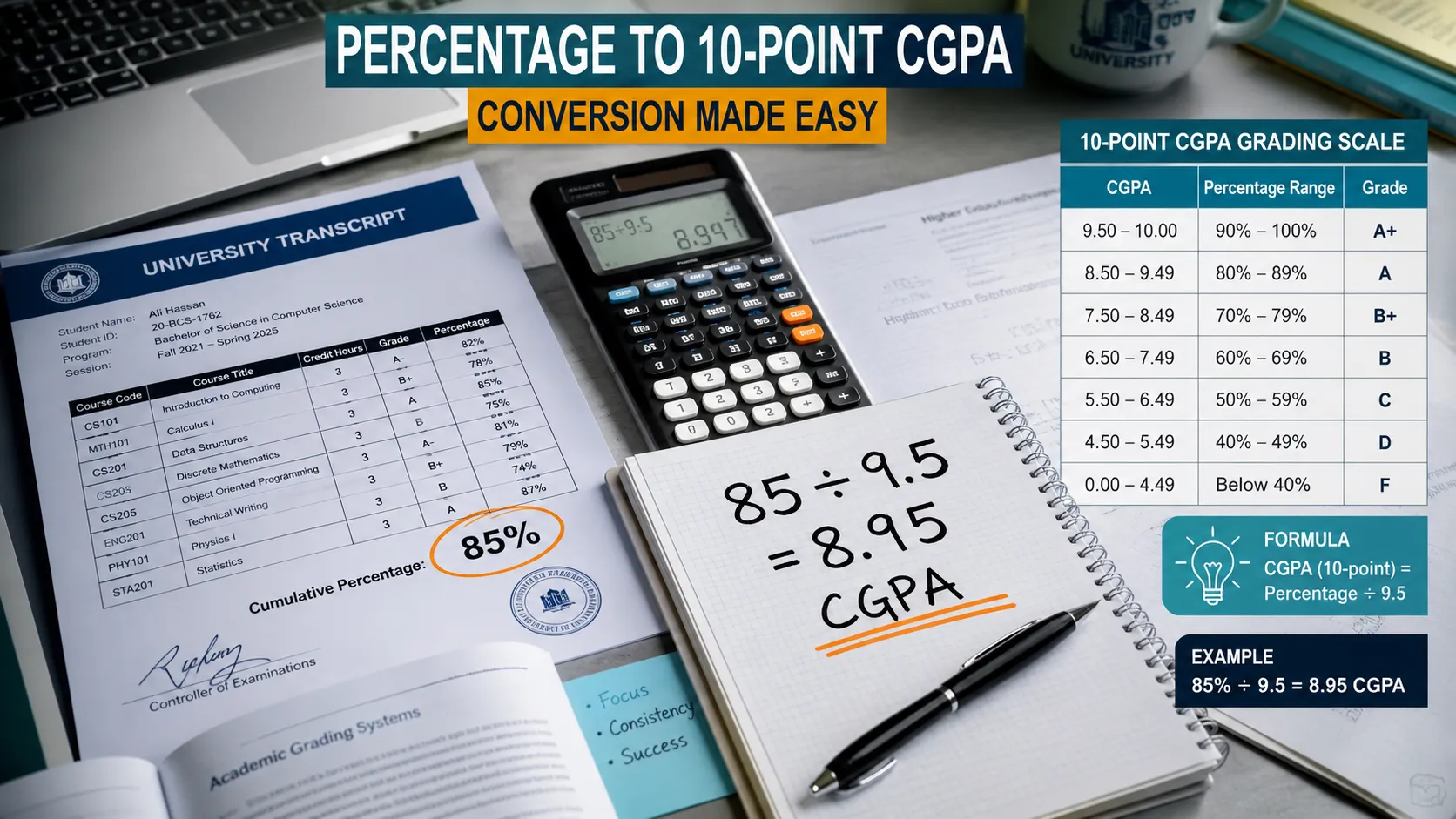
To convert a percentage to a 10-point CGPA (used in India and many Asian universities), divide your percentage by 9.5. For example, 85% ÷ 9.5 = 8.94 CGPA. For the US 4.0 scale, never use simple division — instead, map your percentage to the equivalent letter grade bracket, since the two systems are non-linear and structurally incompatible.
Key Takeaways
- The formula you use depends on which grading scale your target institution uses — 10-point, 4.0, or 5.0.
- For a 10-point CGPA scale, the standard formula is: Percentage ÷ 9.5 = CGPA.
- Converting to a US 4.0 scale requires bracket-based mapping, not arithmetic division.
- For formal university admissions, always request an official evaluation from a certified body like WES (World Education Services) or ECE.
- Universities in different countries interpret the same percentage very differently — understanding this protects your academic reputation.
Why This Conversion Matters
Not every country speaks the same academic language. A student from Mumbai has a degree that says "78.4%." A student from Boston has a transcript that says "3.4 GPA." A student from London has a "2:1 Honours" classification. To a foreign employer or admissions officer, all three students may be equally qualified — but only if each candidate can communicate their grades in a format the reviewer understands.
Getting this conversion wrong has real consequences. Students who use incorrect formulas have undersold their achievements by as much as a full grade point, costing them scholarships they were entirely eligible for. Others have slightly overstated their GPA using inaccurate conversion tools and faced disqualification for academic misrepresentation. The goal of this guide is to ensure neither happens to you.
Understanding the Grading Landscape
Before applying any formula, you need to know which scale you are converting to. There is no single universal GPA system. The three most common ones you will encounter are:
- The 10-Point CGPA Scale: Used extensively in India (CBSE, SGBAU, many state boards), Pakistan, Sri Lanka, and several Southeast Asian countries.
- The 4.0 GPA Scale: The dominant scale used by universities in the United States, Canada, and several African universities.
- The 5.0 GPA Scale: Used in Australia (sometimes), certain Nigerian institutions, and as a weighted GPA variant in the US for advanced coursework.
Each system has its own internal logic, and you cannot reliably convert between them using the same formula.
Converting Percentage to a 10-Point CGPA Scale
The Standard 9.5 Formula
The most widely recognized conversion formula, officially endorsed by the Central Board of Secondary Education (CBSE) in India, uses 9.5 as the divisor:
CGPA = Percentage ÷ 9.5
Here are a few worked examples:
| Your Percentage | Calculation | Resulting CGPA |
|---|---|---|
| 90% | 90 ÷ 9.5 | 9.47 |
| 82% | 82 ÷ 9.5 | 8.63 |
| 75% | 75 ÷ 9.5 | 7.89 |
| 65% | 65 ÷ 9.5 | 6.84 |
| 55% | 55 ÷ 9.5 | 5.79 |
Why 9.5 and Not 10?
The 9.5 divisor is not arbitrary. The CBSE grading system was designed so that the highest achievable CGPA (10.0) corresponds to the 95th percentile of students, not 100%. This means a student who scores perfectly in every subject achieves 95% (not 100%), which converts to 10.0. Using 9.5 as the divisor creates a mathematically consistent scale that reflects where a student sits within the academic distribution.
Reversing the Formula (CGPA to Percentage)
If your transcript shows a 10-point CGPA and an employer or university asks for your percentage, the reverse is equally straightforward:
Percentage = CGPA × 9.5
For example, a CGPA of 8.6:
- 8.6 × 9.5 = 81.7%
Converting Percentage to a 4.0 GPA Scale (USA/Canada)
Why Simple Division Fails
The single most common mistake students make when converting to a 4.0 scale is using simple arithmetic. You will often see suggestions like "divide your percentage by 25" or "divide by 100 and multiply by 4." These formulas are mathematically meaningless because the US grading system is non-linear.
In the US, a 60% is a failing grade (equivalent to 0.0 or 1.0 on the 4.0 scale). In India, a 60% is a respectable first-class pass. If you divide 60% by 25, you get 2.4 — which presents a failing grade as a decent B. That misrepresentation can damage your credibility in an application.
The Bracket-Based Mapping Method
The only accurate way to estimate a percentage-to-4.0 GPA conversion is to first determine the equivalent letter grade in your home system, then map that to the US letter grade equivalent.
For students from systems with rigorous grading (India, UK, certain South Asian and Middle Eastern universities), a widely referenced mapping is:
| Home Percentage | Home Grade Equivalent | US Letter Grade | US GPA |
|---|---|---|---|
| 90% – 100% | O / A+ | A+ | 4.0 |
| 75% – 89% | A / First Class | A | 3.7 – 4.0 |
| 65% – 74% | B / Upper Second | B | 3.0 – 3.6 |
| 55% – 64% | C / Second Class | C | 2.0 – 2.9 |
| 45% – 54% | D / Pass | D | 1.0 – 1.9 |
| Below 45% | F / Fail | F | 0.0 |
Important: These brackets are general reference points. Different credential evaluation organizations (WES, ECE, NACES members) maintain their own proprietary conversion tables based on country-of-origin and institution reputation. For formal applications, their evaluation takes precedence.
For an immediate estimate based on your specific region, our free Percentage to GPA Converter provides results calibrated to the most common international grading systems.
Official vs. Self-Calculated Conversions: When to Use Each
This distinction is often overlooked, but it is critically important.
When a Self-Calculated Estimate Is Fine
- Filling out preliminary screening forms on employer portals
- Estimating your eligibility before applying to a program
- Personal academic planning and goal-setting
- Including a parenthetical GPA estimate alongside your percentage on a resume (e.g., "78.4%, approx. 3.2/4.0")
When You Must Use an Official Evaluator
If you are applying to a graduate program in the US, Canada, UK, or Australia that specifically requires a converted GPA, you should use a certified credential evaluation service. The most recognized organizations include:
- WES (World Education Services): The gold standard for US and Canadian university applications.
- ECE (Educational Credential Evaluators): Widely accepted by US universities.
- NACES Members: Any organization that is a member of the National Association of Credential Evaluation Services.
These services require you to submit official transcripts from your home institution. They then analyze your specific curriculum, institution reputation, and grading scale to produce a certified evaluation report. The cost typically ranges from $100 to $200 USD.
Never submit a self-calculated GPA in a field that specifically asks for an evaluated score. It is considered academic misrepresentation even if your calculation happens to be accurate.
Common Conversion Mistakes to Avoid
Mistake 1: Using the same formula for every country.
A 75% from a UK university, an Indian university, and a Pakistani university do not represent the same level of performance. Grading rigor varies enormously between institutions and countries.
Mistake 2: Converting CGPA when the university wants raw percentage.
Some Indian universities state in their admissions criteria that they want a "percentage-equivalent." Do not submit your CGPA number. Calculate the reverse and provide the percentage.
Mistake 3: Ignoring grade forgiveness or supplemental marks.
If you retook a paper and your university records the higher mark on the transcript, your calculated CGPA reflects the corrected score. But some evaluation bodies consider the original attempt. Always check the policy of the evaluating organization.
Mistake 4: Applying a conversion without knowing the exact scale your home university uses.
Not all Indian universities use the 9.5 CBSE formula. Some use 10, some use 9, and some have their own institutional grading systems. Check your university's official transcript policy before applying any formula.
Percentage to CGPA Conversion for Specific Purposes
For Study Abroad Applications
Check the target program's minimum GPA requirement first. If a US Master's program requires a 3.0 GPA, and your Indian percentage is 72%, use the bracket method to estimate whether you qualify. Then, apply and mention in your Statement of Purpose that your academic record will be supported by an official WES evaluation.
For Campus Placements in India
Most campus recruiters in India simply want your raw CGPA on the 10-point scale. If your university only reports percentages, use the 9.5 formula to calculate and present your CGPA. This is standard practice and universally understood by Indian HR departments.
For International Job Applications
Include both your percentage and your estimated GPA conversion in parentheses on your resume. This provides the international hiring manager with immediate context without requiring them to look up conversion charts.
Frequently Asked Questions (FAQ)
Why does the 10-point scale use 9.5 instead of 10?
The 9.5 multiplier was established by CBSE to account for the grading philosophy that a "perfect" score corresponds to the 95th percentile of performance, not an absolute 100%. It creates a consistent statistical distribution across the academic population.
Will converting my grades lower my perceived performance?
Not if you use the correct method. This is precisely why you should never use simple division for the US 4.0 scale. A correctly executed bracket-based conversion acknowledges that a 70% in a rigorous system is equivalent to an A or B in the US context — which is exactly how certified evaluators treat it.
Can I just list my percentage on a US resume?
You can, but it will be meaningless to most US hiring managers who are unfamiliar with international percentage systems. Providing both the percentage and an approximate GPA conversion significantly improves readability and professionalism.
My university uses a 7-point scale. How do I convert?
Divide your 7-point scale CGPA by 7 to get your percentage position (e.g., 5.6/7.0 = 80%), then apply the bracket method to convert to a 4.0 scale. Always include a note explaining your institution's grading scale.
conclusion
Converting a percentage to a CGPA is straightforward once you know which scale you are targeting. For 10-point systems, divide by 9.5. For 4.0 systems, use bracket mapping rather than direct division. The approach you use — self-calculated versus professionally evaluated — depends entirely on the formal requirements of the institution or employer you are presenting to.
For a quick, accurate estimate without the math, use our Percentage to GPA Converter. For a deeper understanding of how cumulative GPAs are built from individual semester scores, read our guide on GPA vs SGPA vs CGPA Explained.